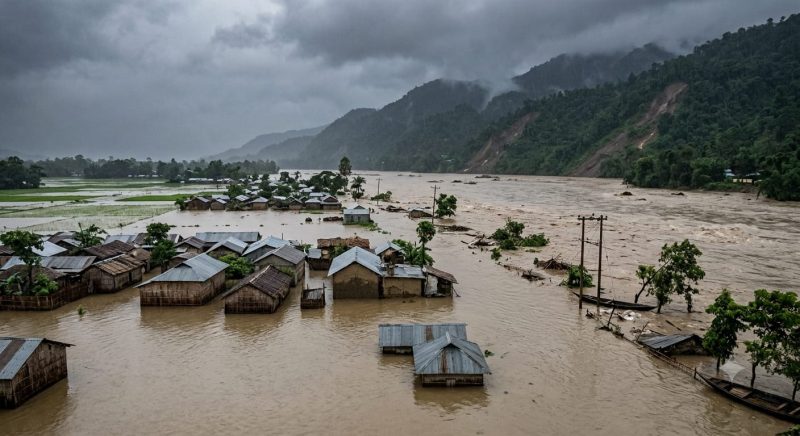
Every year, when the Teesta swells and inundates vast stretches of northern Bangladesh, a familiar debate resurfaces. Fingers are pointed across the border, accusations fly, and public anger intensifies. In Bangladesh, many ask whether India is responsible for the devastation. The question is understandable. After all, the Teesta is a shared river, and Bangladesh, as the downstream country, inevitably bears the consequences of decisions taken upstream.
Yet, while Bangladesh’s grievances against India over the Teesta are legitimate and long-standing, the increasingly frequent and severe floods on the river are, first and foremost, a manifestation of climate change. The Teesta’s growing volatility is no longer simply a story of upstream versus downstream politics; it is increasingly a story of a changing Himalayan climate affecting millions on both sides of the border.
This distinction matters because misdiagnosing the problem will prevent both countries from finding lasting solutions.
The Teesta originates in the eastern Himalayas, a region now experiencing some of the fastest rates of warming in the world. Rising temperatures are accelerating glacial melt, altering snowfall patterns, and increasing the frequency of extreme rainfall events. Scientists have repeatedly warned that Himalayan rivers will become increasingly erratic, marked by prolonged dry spells punctuated by sudden, devastating floods.
Recent events bear this out. The catastrophic glacial lake outburst flood in Sikkim in October 2023 offered a glimpse into the future. Triggered by the bursting of South Lhonak Lake, swollen by accelerated glacial melt and intensified by extreme rainfall, the disaster destroyed infrastructure, claimed lives, and devastated communities in India’s Sikkim and West Bengal before surging downstream toward Bangladesh. Nature did not stop at political boundaries.
Similarly, extreme monsoon events have become more common across the broader Ganges-Brahmaputra-Meghna basin. What was once considered exceptional rainfall is increasingly becoming the norm. Rivers such as the Teesta now experience dramatic fluctuations in discharge within very short periods, overwhelming existing infrastructure and flood management systems.
India also suffers from these changes. Communities in Sikkim and northern West Bengal have repeatedly experienced landslides, flash floods, dam failures, and displacement. Infrastructure worth billions of dollars has been destroyed. Hydropower projects, once viewed as engines of regional development, are now increasingly vulnerable to climate-induced disasters.
Check Out: Flash Floods – Causes, Effects, Prevention and Management
But if climate change affects both countries, it does not affect them equally.
Bangladesh occupies the downstream end of the Teesta basin. Geography alone ensures that when excessive water rushes down from the Himalayas, Bangladesh absorbs much of the impact. The country’s northern districts—Lalmonirhat, Kurigram, Nilphamari, Rangpur, and Gaibandha—are densely populated and heavily dependent on agriculture. Millions live on floodplains and river islands with limited capacity to absorb repeated shocks.
Consequently, when extreme rainfall in the upstream catchment causes sudden increases in river flow, Bangladesh experiences disproportionate losses. Cropland disappears under water, homes are washed away, livestock perish, and vulnerable communities are displaced. In many cases, people who are already among the country’s poorest bear the highest costs.
This reality reinforces rather than diminishes Bangladesh’s longstanding concerns regarding India’s management of the Teesta.
For decades, Bangladesh has argued that upstream interventions have significantly altered the river’s natural flow. During the dry season, the country frequently experiences water shortages that severely affect agriculture, fisheries, and ecosystems in the north. The failure to conclude the long-discussed Teesta Water Sharing Treaty has become one of the most persistent irritants in bilateral relations.
Bangladeshis also remember occasions when sudden releases of water from upstream barrages, particularly at Gazaldoba, exacerbated flooding downstream. The perception that gates have been opened without adequate prior notification has generated understandable resentment. Even if extraordinary climatic conditions necessitate emergency releases, the absence of timely communication undermines trust.
These grievances are neither imagined nor insignificant. They deserve serious attention.
However, it would be simplistic and strategically unwise to attribute every flood solely to India’s actions. The volume of water now coursing through the Teesta during extreme weather events often exceeds what existing infrastructure was designed to manage. Reservoirs and barrages built for twentieth-century hydrological conditions are increasingly struggling to cope with twenty-first-century climate realities.
In other words, climate change is making old disputes more dangerous.
The challenge, therefore, is not merely to divide water; it is to manage climatic uncertainty jointly.
This is precisely where India has an opportunity to demonstrate leadership.
As the upstream and larger country, India possesses both greater capacity and greater responsibility. Signing the Teesta Water Sharing Treaty would not eliminate floods, nor would it halt climate change. But it would establish an institutional framework for cooperation, transparency, and trust at a moment when all three are urgently needed.
A treaty could facilitate real-time data sharing, coordinated flood forecasting, advance notification of emergency water releases, and joint river basin management. Such mechanisms would save lives on both sides of the border.
More importantly, concluding the treaty would send a powerful political message. At a time when climate change is intensifying regional vulnerabilities, India could demonstrate that power asymmetries need not translate into inequities in outcomes. It could show that responsible upstream stewardship is compatible with national interest.
Failing to do so carries costs for both countries.
Bangladesh will continue to shoulder a disproportionate burden of climate-induced flooding while simultaneously facing chronic dry-season water scarcity. Frustration within Bangladesh is likely to deepen, fuelling anti-India sentiment and complicating broader bilateral cooperation.
India, meanwhile, risks forfeiting an opportunity to occupy the moral high ground in South Asia. Regional leadership is not merely a function of economic or military power; it is also measured by the willingness to accommodate the legitimate concerns of neighbors.
The geopolitical dimension cannot be ignored either.
Bangladesh’s consideration of the Teesta River Comprehensive Management and Restoration Project with Chinese support reflects not merely economic pragmatism but also strategic signaling. Unsurprisingly, such a project has generated concern in New Delhi, given the broader Sino-Indian rivalry.
Yet this is a dilemma India can resolve with relative ease.
Rather than viewing Chinese involvement solely through a geopolitical lens, India should ask why Bangladesh feels compelled to seek external support in the first place. The answer lies partly in the prolonged absence of a Teesta agreement. A fair and comprehensive water-sharing arrangement, combined with deeper cooperation on river management, would significantly strengthen confidence and reduce incentives for external balancing.
The Teesta should not become another theatre of great-power competition. It should instead become a model for climate cooperation in South Asia and the broader region.
Climate change is rewriting the hydrological realities of the Himalayas. Neither India nor Bangladesh can stop this transformation alone. But they can choose how they respond.
The waters of the Teesta will continue to rise and fall. Whether they become a source of conflict or cooperation depends on decisions made not by nature, but by politics.
And politics, unlike climate change, remains entirely within human control.
Climate change is also forcing South Asia to rethink the very nature of water governance. Rivers such as the Teesta do not recognize political borders. They are ecological systems that connect glaciers, mountains, plains, forests, wetlands, and communities across several countries. Yet, water governance in the region remains overwhelmingly bilateral, fragmented, and rooted in twentieth-century assumptions about relatively stable hydrological patterns. Those assumptions no longer hold.
The Himalayan region—often described as the world’s “Third Pole” because of its vast reserves of ice and snow—is warming faster than the global average. Glaciers are retreating, glacial lakes are expanding, and extreme precipitation events are becoming more frequent. These developments pose shared risks to all countries dependent on the Himalayan river systems. No country, whether upstream or downstream, can effectively monitor, predict, or respond to these changes in isolation.
Indeed, climate change is transforming transboundary rivers from questions of water allocation into questions of collective survival.
For India and Bangladesh, this reality creates both an imperative and an opportunity. The imperative is obvious: without deeper cooperation, both countries will remain vulnerable to increasingly severe floods, droughts, riverbank erosion, and ecological degradation. Data sharing during disasters, coordinated reservoir operations, joint flood forecasting, and collaborative basin management are no longer optional diplomatic gestures; they are essential climate adaptation measures.
The opportunity is equally significant. A robust India-Bangladesh framework on the Teesta could serve as a model for climate-resilient river governance across South Asia. Rather than viewing water solely through the lens of sovereignty and zero-sum competition, both countries could pioneer a more cooperative approach based on shared vulnerability, scientific collaboration, and equitable benefit-sharing.
Such cooperation should not stop at the India-Bangladesh border.
The broader geography of South Asian rivers makes regional cooperation indispensable. Most of the major rivers flowing through India and Bangladesh—including the Brahmaputra, Teesta, and Ganges tributaries—originate in the Tibetan Plateau, under Chinese jurisdiction. Climate-induced changes occurring in the upper Himalayan and Tibetan regions, therefore, have direct consequences for millions of people downstream in India and Bangladesh.
This makes a compelling case for expanding scientific and hydrological cooperation beyond bilateral arrangements. Greater data-sharing on glacial melt, snowpack conditions, precipitation patterns, and river discharge among China, India, and Bangladesh could significantly improve forecasting capabilities and disaster preparedness throughout the basin. Early warning systems for glacial lake outburst floods, for example, would be considerably more effective if information flowed seamlessly across borders.
Admittedly, geopolitical rivalries—particularly between India and China—complicate such prospects. Yet climate change does not pause for geopolitics. The accelerating pace of environmental change in the Himalayas means that strategic competition and environmental cooperation will increasingly have to coexist.
In this context, stronger India-Bangladesh cooperation assumes even greater significance. If New Delhi and Dhaka can establish trust-based, climate-sensitive mechanisms for managing shared rivers, they will not only improve bilateral relations but also lay the foundations for broader regional water diplomacy that involves China and other Himalayan stakeholders. In an era of climatic uncertainty, cooperation among lower and upper riparians alike is not an act of generosity; it is a strategic necessity.
The future of South Asia’s rivers will ultimately depend on whether countries continue to treat water as a source of geopolitical contestation or begin to view it as a shared ecological commons demanding collective stewardship.
Also Check Out: Glacial Lake Outburst Flood (GLOF) -Causes, Impact, Solution
We hope you all liked this post! Please, comment below if you have any suggestions, comments, or feedback! We #envpk love hearing from our readers! Thanks!
This article is contributed by: Syed Shahnawaz Mohsin (pen name: Simon Mohsin) is a multidisciplinary professional with 15+ years of experience in political science, foreign affairs, business management, and media. An entrepreneur with ventures in agro, toys, and artwork, he also consults in training, recruitment, and the sports/health sectors. Mohsin is a certified fitness trainer, former professional cricketer, and published writer on sports, politics, and foreign affairs. He works as a translator, editor, public speaker, and adjunct faculty member. He writes short stories, flash and micro fictions, and children’s stories in Bangla and English. He has published his first Bangla socio-political novel (2025). Mohsin is now expanding his work in academia and research on business and social sciences.