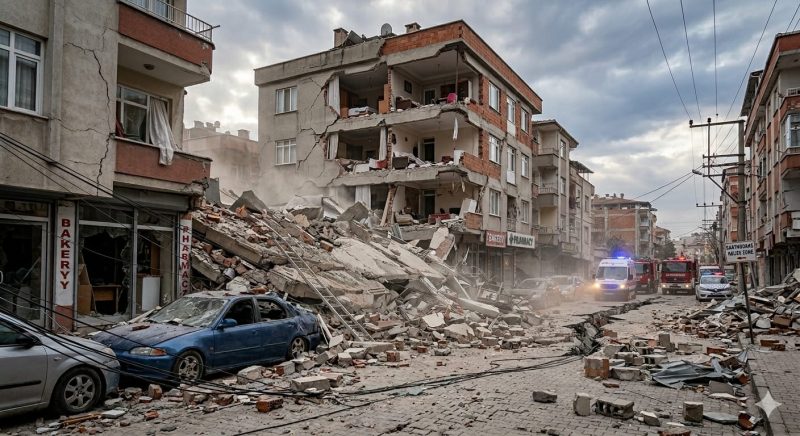
Earthquake: The rapid movement of the rocky outer layer of the Earth causes earthquakes, which shake the surface of the planet. When the Earth’s internal energy, typically in the form of strain in rocks, unexpectedly releases, earthquakes result. Waves from earthquakes carry this energy to the Earth’s surface. Seismology is the study of earthquakes and the waves they produce (from the God seismos, “to shake”). Seismologists are researchers who focus on earthquakes.
Measurement: Seismometer is an instrument used to measure the vibrations caused by earthquake. Vibrations are displayed on seismometers and earthquake can be detected easily. A Richter scale is used to measure the strength of earthquake. An earthquake of magnitude 6.3 is rated as strong earthquake for example : In October 2015, an Earthquake of magnitude 8.1 hit the areas of Pakistan and Hindu Kush range and left ground raptures.
Also check out: Occupational Health d Safety – Hazards and Protection
Causes of Earthquake: The causes of earthquakes can be both man made and natural. The man made cause is fracking and natural causes are plate tectonics, volcanic eruptions and isostatic adjustments.
1. Plate tectonics: The earth’s crust is a rocky layer with a range of thicknesses that extends from 65 kilometers beneath the continents to around 10 kilometers under the oceans. The crust is made up of ‘plates,’ or sections, that range in size from a few hundred to thousands of kilometers. The movement along the plate boundaries that results from stress in the crust includes:
- a) pulling away from one another,
- b) pushing against one another,
- c) sliding sideways with respect to one another.
These motions are all connected to earthquakes. For instance, Pakistan’s earthquake activity is primarily focused in the country’s north and west, at the border between the Indian plate and the Iranian plate.
2.Volcanic Earthquake: Magma, or molten rock, is kept in reservoirs beneath volcanoes. The rock that this magma squeezes through as it rises may crack, resulting in earthquakes, typically with magnitudes not much higher than 5.0. Sometimes, before a volcanic eruption, magma may gather in a high level reservoir and as it flows around, it will produce bursts of continuous vibration known as volcanic tremor. Seismographs (earthquake recorders) are highly helpful for monitoring volcanoes in order to provide warnings of an approaching eruption because of these precursors.
3.Fracking: Studies are placing more emphasis on the seismic effects of the controversial fracking method for extracting gas. Studies have shown that procedures like fracking, which is the process of extracting oil and gas, can cause manmade earthquakes. In order to obtain oil and natural gas, which cause earthquakes, fracking entails blasting water, sand, and chemicals deep into the soil.
You might also be interested in: Increasing Natural Disasters due to Climate Change
Effects of Earthquake :
1.Ground Shaking: The most well-known consequence of earthquakes is shaking of the ground. Strong ground shaking caused by earthquakes can cause damage to or destruction of buildings, difficulty in standing or moving for people and animals, and the flinging of objects.
2.Tsunami:The sudden vertical shift of a sizable portion of the ocean floor after an undersea earthquake results in tsunamis, which are water waves.
3.Landslides:Tree falls and landslides that develop on steep slopes are the most frequent types of earthquake-induced landslides. Block slides, soil, and rock slumps, as well as shallow debris slides that originate on steep slopes, do occur, though they are less often than the others.
Read: What Is Causing Sudden Increase In Sinkholes Around The World?
4.On humans : During earthquake, buildings, walls, bridges, items falling from the sky, glass breaking, and furniture starts collapsing. Since the impact of large, heavy things can be fatal, debris from collapsing structures is one of the main hazards during an earthquake. Earthquakes have the potential to create fires, cause electricity poles to topple, expose live wires, and more.
Have a look at: What is Climate Change Adaptation? – Importance and Methods
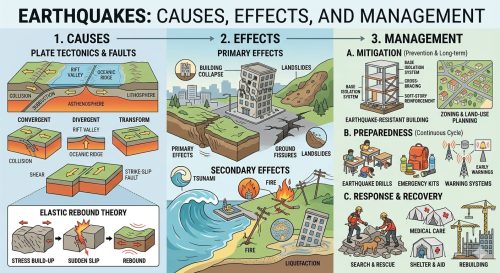
Management of Earthquakes:
Before Earthquake:
- Determine the best locations to “drop, cover, and hold on” in each area of your house or structure in case of an earthquake.
- Make sure the following items are in your emergency kit if earthquakes are common in your area:
- Foods that are high in energy and non-perishable.
- Medication in sealed bottles or other containers.
- Together with your loved ones, coworkers, and friends, create an emergency plan for calamities.
After Earthquake:
- Remain calm after a calamity.
- Attend to any wounds or seek expert medical attention. To lower the risk of infection, small wounds should be cleaned with soap and water before being dressed. As required, change the bandages.
- Call 911 to alert emergency responders of serious injuries.
- Help others as instructed.
- Pack up your emergency supplies and make a calm, methodical exit.
- Avoid using elevators. Watch for any aftershocks.
Also Check out: What is a Healthy Environment? Why is it important?
We hope you all liked this post! Please, comment below if you have any suggestions, comments, or feedback! We #envpk love hearing from our readers! Thanks!