
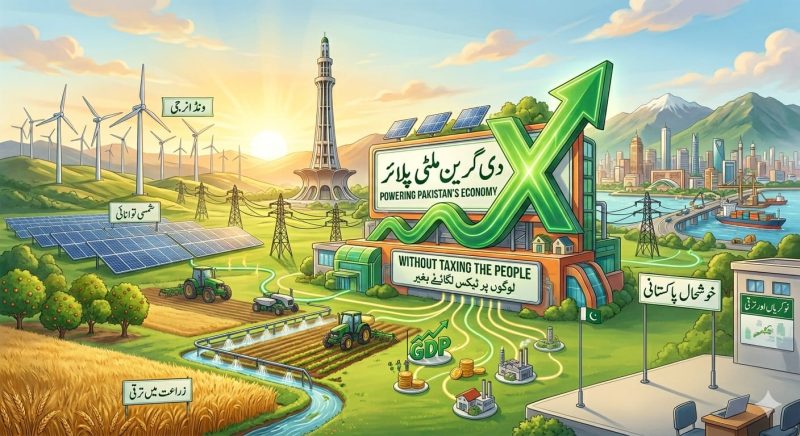
Is it Possible to powering Pakistan’s economy without putting the burden of taxed on the people?
Pakistan stands at a critical crossroads. The nation is currently caught between the soaring costs of imported fossil fuels and the debilitating impact of high electricity bills on the average citizen. To break this cycle, the government must pivot toward alternative energy, not as a luxury, but as an economic engine.
The challenge lies in execution: how cans the state transition to green energy without shifting the financial burden onto a population already grappling with inflation? By focusing on decentralized production, local manufacturing, and innovative financing, Pakistan can turn its energy crisis into an economic windfall.
1. Incentivize Prosumers through Solar Micro-Grids
The traditional model of centralized power generation is becoming increasingly inefficient due to massive line losses and circular debt. Instead of focusing solely on mega-projects, the government should facilitate the rise of Prosumers, citizens who both produce and consume energy.
Community Solar Models: In low-income urban areas or rural villages, the government can sponsor community-owned solar micro-grids. By allowing neighborhoods to pool resources into a shared solar farm, the cost per household drops significantly.
Net-Metering for the Masses: While net-metering exists, it is often tied to bureaucratic red tape. Streamlining this process ensures that middle-class families can see an immediate return on investment, effectively lowering their monthly expenses while feeding excess power back into a starving national grid.
Check Out: Pakistan’s Energy Crisis – The Ever-growing Energy Crisis
Is Transition To Clean Energy Crucial For Our Survival?
2. Localization: Moving from Importers to Manufacturers
Currently, Pakistan imports the vast majority of its solar panels, inverters, and lithium batteries. This drains foreign exchange reserves. To boost the economy, the government must transition from an installer mindset to a manufacturer mindset.
Special Economic Zones (SEZs): Creating tax-free zones specifically for renewable energy hardware manufacturing can attract foreign direct investment (FDI), particularly from China.
Job Creation: A local assembly line for solar components would create thousands of technical jobs for the youth. By training the local workforce in green tech, the government transforms a segment of the unemployed population into a productive, high-skill labor force.
3. Redirecting Subsidies, Not Increasing Taxes
A major mistake in economic policy is the reliance on regressive taxes. Instead, the government should perform a subsidy swap.
Phasing out Fossil Fuel Subsidies: The billions currently spent on subsidizing imported oil and gas for power plants should be gradually redirected toward zero interest loans for green energy startups and home solar installations.
Green Bonds: The government can issue Green Bonds to raise capital specifically for renewable projects. This allows the state to fund infrastructure without adding to the immediate tax burden of the common man.
4. Agrivoltaics: Solving Energy and Food Security
Pakistan’s economy is fundamentally agrarian. The government can boost the GDP by promoting Agrivoltaics, the simultaneous use of land for both solar power generation and agriculture.
Dual-Use Land: By installing solar panels at a height that allows crops to grow underneath, farmers can generate their own electricity for tube wells, reducing their reliance on expensive diesel.
Efficiency: The shade from panels can actually reduce water evaporation in certain crops, leading to better yields in Pakistan’s increasingly hot climate. This stabilizes food prices for the public while increasing the farmer’s profit margin.
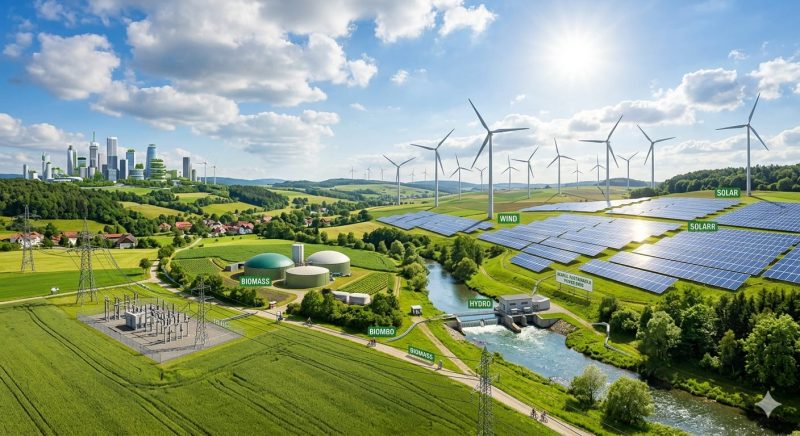
5. Waste-to-Energy: Cleaning Cities, Powering Homes
Urban centers like Karachi and Lahore face a massive waste management crisis. The government can partner with private firms to build waste-to-energy plants.
Circular Economy: Converting municipal solid waste into electricity or biogas solves two problems at once: it cleans the environment (reducing healthcare costs related to pollution) and provides a steady, baseload power source that doesn’t depend on the sun or wind.
6. Modernizing the National Grid (The Smart Approach)
Even the best renewable energy plan will fail if the national grid cannot handle variable input.
Smart Grid Investment: Instead of building more coal plants, the government should invest in AI-driven smart grids. These grids can balance the load between solar, wind, and hydel sources in real-time, reducing the forced outages that cripple small businesses.
Removing Capacity Payments: By diversifying the energy mix, the government can slowly negotiate its way out of the “capacity payment” trap of Independent Power Producers (IPPs), which is the primary reason for current high electricity tariffs.
Conclusion: The Path Forward
The transition to alternative energy in Pakistan must be framed as a poverty alleviation strategy, not an environmental hobby. By localizing manufacturing and empowering the individual citizen to produce their own power, the government can stimulate industrial growth and stabilize the Rupee.
If the state acts as a facilitator rather than a tax collector in this sector, Pakistan can achieve a green recovery, one where the air is cleaner, the grid is stable, and the pockets of the people remain full. The sun and wind are free; it is only the policy that costs us.
Also Check Out: Unreliable Energy: Hormuz Crisis Must Be Our Green Catalyst
We hope you all liked this post! Please, comment below if you have any suggestions, comments, or feedback! We #envpk love hearing from our readers! Thanks!