
The Silent Predators: How Open Manholes are Claiming Lives and Eroding Pakistan’s Urban Future
In the bustling streets of Pakistan’s major metropolises, a silent and deadly predator lurks in plain sight. From the narrow alleyways of Karachi’s Lyari to the busy intersections of Lahore’s Ferozepur Road, open manholes and uncovered drainage pits have become a recurring nightmare for citizens. What should be a basic piece of urban infrastructure, a cover to protect the public from sewage systems has instead become a death trap that claims dozens of lives every year, and most of them innocent children.
As of late 2025, the crisis has reached a tipping point. In Karachi alone, over 22 children have lost their lives this year after falling into these gaping voids. These are not merely accidents; they are an indictment of a broken civic system, a failure of governance, and a chilling reminder of the environmental decay threatening the country’s urban future.
A Trail of Tragedy: The Human Cost
The statistics are harrowing, but the individual stories are heart-wrenching. In early December 2025, a three-year-old boy named Ibrahim was walking with his mother near NIPA Chowrangi in Karachi. In a split second, he slipped into an uncovered manhole and was swallowed by the city’s underground drainage network. It took 15 hours of desperate searching by volunteers and rescue workers to recover his lifeless body a kilometer away.
Similar tragedies have unfolded across the country. In Punjab, seven-year-old Rehan died after falling into a manhole while on his way to school in Lodhran. These incidents share a common, agonizing theme: a momentary lapse in visibility or a child’s natural curiosity leads to a fatal plunge into toxic, fast-flowing sewage.
Why are they still open? The reasons for these death holes are a complex mix of negligence and social desperation:
- Theft for Scrap: Cast-iron manhole covers are frequently stolen by drug addicts or those in extreme poverty to be sold as scrap metal for a few hundred rupees.
- Bureaucratic Apathy: When a cover is reported missing, multiple agencies from the Water and Sewerage Corporation to local municipal committees often trade blame rather than taking immediate action.
- Poor Quality: Many replacement covers are made of substandard cement that collapses under the weight of heavy traffic, leaving a fresh hazard in its wake.
The Environmental Toll: Beyond the Surface
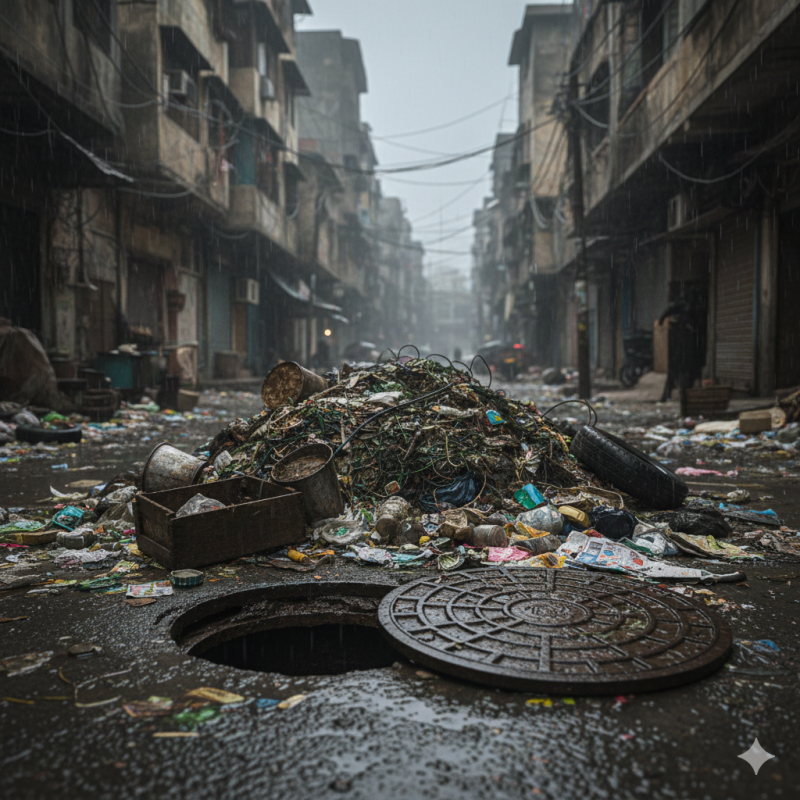
While the immediate danger is physical, the environmental impact of open manholes and drains is equally catastrophic. They act as open wounds in the city’s anatomy, allowing pollutants to seep into the very lifeblood of the community.
1. Groundwater Contamination
Open drainage systems allow domestic and industrial waste to seep into the soil. In cities like Rawalpindi and Lahore, this “seepage” often reaches the shallow aquifers used by residents for drinking water. The result is a surge in waterborne diseases such as Cholera, Typhoid, and Hepatitis A and E.
2. Air Pollution and Toxic Gases
Open sewers are more than just an eyesore; they are chemical reactors. At night, as temperatures drop, these drains release poisonous gases like Hydrogen Sulfide (H2S) and Methane (CH 4 ). These gases not only contribute to the foul odor that plagues urban neighborhoods but also cause respiratory issues for residents living nearby.
3. Breeding Grounds for Disease
During the monsoon season, open manholes and clogged drains become stagnant pools of filth. These are the primary breeding grounds for mosquitoes, the vectors for Dengue and Malaria. The “man-made” nature of these health crises is clear: by failing to cover and maintain drains, authorities are inadvertently cultivating the next epidemic.
Check Out: The Invisible Chemicals Polluting Pakistan’s Drinking Water
The Domino Effect on Urban Life
The presence of open manholes fundamentally changes how people interact with their city. It erodes the “right to the city” the basic freedom to walk safely in one’s own neighborhood.
Economic Paralysis: Business owners near open drains report a decrease in foot traffic due to the smell and the physical danger. It discourages economic activity and lowers property values.
Psychological Trauma: For parents in Pakistan, a simple trip to the store with a toddler is now fraught with anxiety. The sight of a half-broken stick or a loose stone placed by a kind stranger to mark a hole is a constant reminder that the state has failed to protect them.
Infrastructure Decay: When manholes are left open, solid waste and plastic are thrown inside, leading to massive blockages. This causes urban flooding during the rains, further damaging roads and buildings.
The Path Forward: Accountability and Innovation What Should We Do?
Solving the manhole crisis requires more than just buying new lids; it requires a systemic overhaul of how Pakistan manages its urban safety.
Transition to Non-Recyclable Materials: Authorities must stop using cast-iron covers that have resale value. Moving to heavy-duty reinforced plastic or high-grade composite materials would eliminate the incentive for theft.
Digital Mapping and GPS: Using simple mobile apps, municipal workers and citizens should be able to geotag and report open manholes. A centralized Urban Safety Dashboard would hold specific officers accountable for repairs within a 24-hour window.
Unified Governance: The current patchwork of authorities where no one knows if a hole belongs to the KMC, the KDA, or the Water Board must end. A single empowered authority for urban safety is essential.
Criminal Liability: In cases of death due to negligence, the responsible officials must face criminal charges. A child’s life should not be dismissed as a municipal oversight.
Conclusion
An open manhole is a symbol of a city in retreat. It represents a disconnect between the grand promises of Smart Cities and the grim reality of a toddler being swallowed by sewage. Pakistan cannot claim to be modernizing while its most vulnerable citizens are at risk of dying simply by walking on the street.
The covers must be replaced, the drains must be desilted, and the officials must be held to account. Until then, every open manhole remains a silent testament to a collective failure that the nation can no longer afford to ignore.
Also Check Out: Hudiara Drain Menace and Its Terrible Environmental Problems
We hope you all liked this post! Please, comment below if you have any suggestions, comments, or feedback! We #envpk love hearing from our readers! Thanks!