
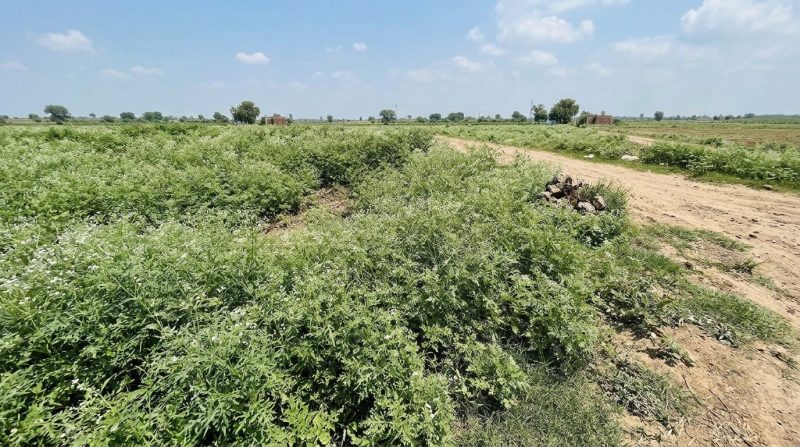
Every winter, Pakistan’s major urban centers brace themselves for the inevitable onslaught of toxic smog. Headlines dominate with air quality indices, respiratory warnings, and political mudslinging over crop burning. Yet, as the winter smog clears, a far more insidious, permanent, and green environmental threat continues to carpet our roadsides, empty plots, and school playgrounds entirely unnoticed.
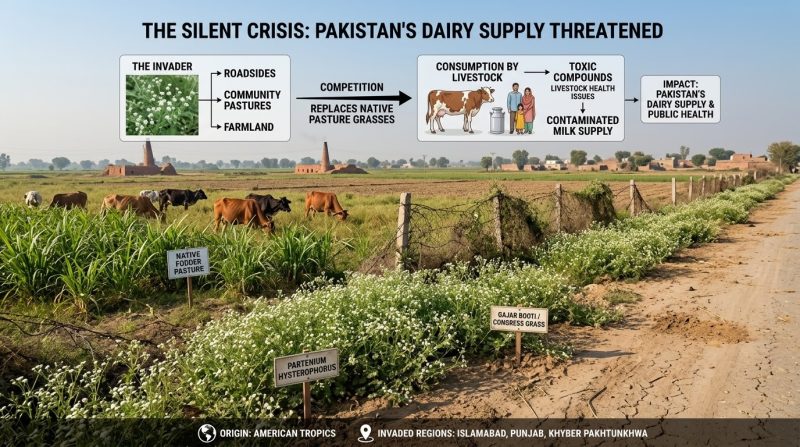
Locally dubbed Gajar Booti or Congress grass, Parthenium hysterophorus acts as a silent biological invader aggressively damaging Pakistan’s public health, agricultural stability, and native biodiversity. This ecological crisis hides right under our noses. The weed originally hailed from the American tropics and likely hitched a ride into South Asia decades ago inside contaminated grain shipments.
Fast forward to today, and it has evolved into one of the country’s most stubborn botanical threats. It takes over rapidly. From Islamabad’s scenic green belts down to the farmland of Punjab and the fertile valleys of Khyber Pakhtunkhwa, this weed claims territory at a terrifying speed. It feeds on civic neglect—choking highways, train tracks, vacant housing plots, and overgrazed community pastures alike.
The real danger of Gajar Booti lies in its chemical makeup, specifically a toxic compound
called parthenin. Found throughout the plant’s leaves, stems, and microscopic pollen grains, this chemical triggers intense allergic reactions in both humans and livestock. Walk past a weed-choked vacant plot in any major city, and you aren’t just looking at an eyesore—you are stepping into a public health hazard.
Its feather-light pollen rides the wind effortlessly, triggering immediate respiratory misery like allergic rhinitis, bronchitis, and sudden asthma attacks. Brush against it physically, and you risk severe contact dermatitis, a condition that leaves people battling agonizing skin rashes, peeling, and swelling for months at a time.
Move out to rural Pakistan, and the crisis hits even harder because local livelihoods depend entirely on farming and livestock. A single Gajar Booti plant drops up to 25,000 seeds. This massive reproductive rate lets it starve the soil of nutrients and crowd out native forage. When local vegetation dies off, livestock run out of options. Dairy cattle naturally hate the bitter weed, but sheer hunger eventually forces them to eat it. That is where things take a disastrous turn.
Consuming Gajar Booti causes severe mouth ulcers, digestive toxicity, and skin lesions in livestock. Furthermore, the toxins bleed into the agricultural supply chain; cows that consume even small amounts of the weed produce bitter, tainted milk that is unfit for human consumption.
Check Out: Water Pollution Causing Antibiotic Resistance in Pakistan
Even with an ecological crisis of this scale, Pakistan’s counterstrategy remains dangerously disjointed. Local municipal authorities bear the brunt of managing the invasion on shoestring budgets. They usually resort to erratic pulling by hand or blanket chemical spraying—both of which routinely backfire. Pulling these weeds manually without proper gear exposes underpaid sanitary workers to chronic skin and respiratory illnesses. Then you have the chemical route.
Drenching the ground in heavy herbicides just allows toxic runoff to seep straight into local groundwater tables, poisoning the community water supply. To make things worse, nobody really talks about it. Countless people walk past thick patches of Gajar Booti every single day without realizing that the innocent-looking, white-flowered weed causing their seasonal allergies is actually a hostile biological invader.
Tackling an invasive crisis of this scale means leaning heavily into unified, science-based
strategies. Down at the CABI Regional Bioscience Centre in Rawalpindi, researchers have already shown that biological countermeasures can work wonders. They deployed a tiny insect named Zygogramma bicolorata—regularly called the Parthenium beetle.
This insect feeds exclusively on the weed, ignoring local agricultural crops completely. But keeping these successful experiments confined to small test sites isn’t enough. The entire initiative requires an aggressive nationwide rollout.
At the same time, provincial environmental protection boards have to step up and legally
enforce weed clearance across the commercial and residential real estate sectors. Private developers who let massive housing societies sit empty and overgrown with toxic brush should face heavy financial penalties. Real change, though, requires a grassroots push. Schools, colleges, and local community groups need to roll out neighborhood awareness drives, training regular citizens to safely spot and report new patches before they spread out of control.
It is time to look beyond just winter smog or distant melting glaciers when discussing
Pakistan’s environmental struggles. The rapid spread of Gajar Booti shows how ecological neglect hits home—quite literally. It ruins the air outside our doorsteps, contaminates local dairy supplies, and turns neighborhood parks into genuine health hazards. Our policymakers need to step up and handle these aggressive plant invasions with real structural urgency. If we keep ignoring Gajar Booti in national policy planning, this toxic green weed will simply keep swallowing up the health and future of our communities.
Also Check Out: Pesticide Waste & Illegal Dumping: Legal Solutions in Sindh
References
Makale, F., Rwomushana, I., Lamontagne-Godwin, J., Constantine, K., Gonzalez-Moreno, P., Weyl, P., Day, R., & Nunda, W. (2019). Parthenium: Impacts and coping strategies in Central West Asia. CABI. https://doi.org/10.1079/CABICOMM-62-8182
Shabbir, A., Zalucki, M. P., Dhileepan, K., Khan, N., & Adkins, S. W. (2023). The current and potential distribution of parthenium weed and its biological control agent in Pakistan. Plants, 12(6), Article 1381. https://doi.org/10.3390/plants12061381
Weyl, P., Ali, K., González-Moreno, P., ul Haq, E., Khan, K., Khan, S. A., Khan, M. H., Stewart, J., Godwin, J., Rehman, A., & Sultan, A. (2021). The biological control of Parthenium hysterophorus L. in Pakistan: Status quo and future prospects. Management of Biological Invasions, 12(3), 509–526. https://doi.org/10.3391/mbi.2021.12.3.02
Weyl, P. S. R., Rehman, A., & Ali, K. (2021). The host range and risk assessment of the stem-boring weevil, Listronotus setosipennis (Coleoptera: Curculionidae) proposed for the biological control of Parthenium hysterophorus (Asteraceae) in Pakistan. Insects, 12(5), Article 463. https://doi.org/10.3390/insects12050463
This article is contributed by: Aliza Amir is the Vice President of the Environment Club at Westminster Academy, Islamabad, where she actively leads student-driven sustainability initiatives. Passionate about climate resilience and resource management, Aliza has conducted extensive research into advanced technologies and strategic methods for optimizing household water security. Blending environmental science with engineering, she also utilized 3D modelling software to design a fully sustainable, closed-loop colony engineered to withstand and survive the extreme conditions of the Thar desert.
We hope you all liked this post! Please, comment below if you have any suggestions, comments, or feedback! We #envpk love hearing from our readers! Thanks!


