The Northern areas of Pakistan are not only rich in biodiversity, but also have ecosystems linking forests, glaciers, grasslands, rivers, wildlife and human settlements into an ecosystem.
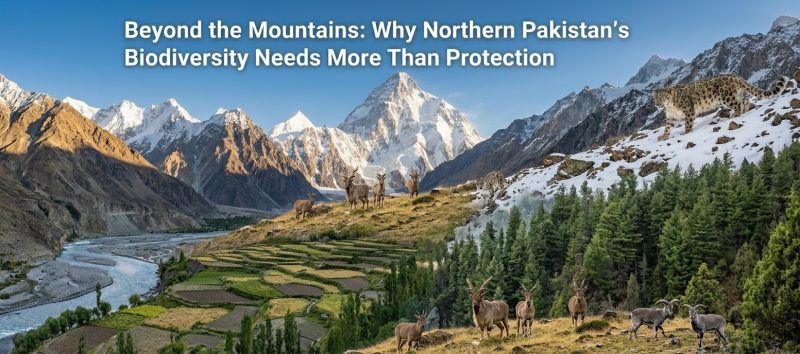
The mountains of northern Pakistan are often used to give the world its first glimpse of the country. The mountain range of Karakoram, the valley of Gilgit-Baltistan, the forests of the Hindu Kush and the alpine terrain around some of Pakistan’s highest peaks all stand for natural beauty. However, behind this image hides something much more important than just the beauty of the area; it is home to one of the most bio-diverse regions in Pakistan. From the snow leopards and the Marco Polo sheep to the markhor, the Himalayan brown bear and the musk deer, and many other plant species, The Forest, Wildlife & Environment Department of Gilgit-Baltistan itself describes the area biodiversity that is valuable not only from a wildlife standpoint, but also from that of the people who depend on the forests, rangelands, rivers and mountains for their sustenance.
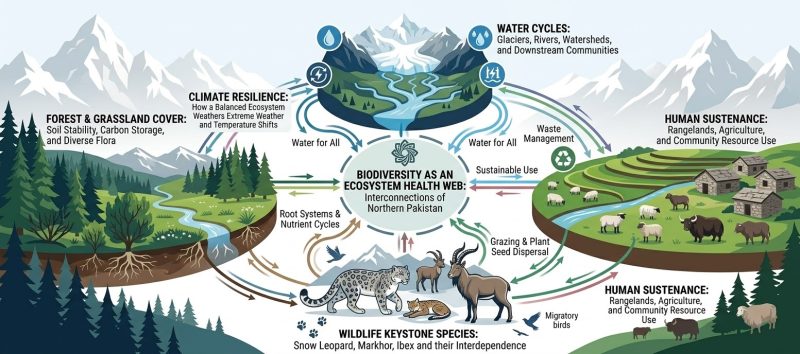
The problem, however, is that in Northern Pakistan, biodiversity is viewed as a wildlife issue rather than an ecosystem issue. Preservation of a particular species is important, but the preservation of the species is not separate from the health of the habitat surrounding the species. The protection of a snow leopard is impossible through the counting of snow leopards alone; it is just as important to consider the food sources, water sources, vegetation, migrations and relationship with surrounding communities of the species. Likewise, the extinction of a plant species cannot be separated from changes in temperature, precipitation, soil, forest cover and land usage. Thus, the question is not just what number of species Northern Pakistan currently has, but rather whether the ecosystems supporting such species will continue to support them.
Check Out: Threats to Natural Ecosystems – Causes, Effects, Management
Unique Plant Species Diversity of Gilgit-Baltistan, Pakistan
Perhaps the most explicit illustration of this ecological complexity is Gilgit-Baltistan. The region is at the confluence of the Himalayas, Karakoram, Hindu Kush and Pamir ranges and has several distinct ecological zones. “The region is mountainous and natural rangelands while forests cover a small part of its total geographical area,” the Gilgit-Baltistan Forest Department said. The department recognizes five major forest types namely mountain subtropical scrub, dry temperate coniferous forests, dry temperate broadleaved forests, sub-alpine forests and northern dry scrub.
Such diversity provides habitat for species which have global significance. As mentioned by the government, some of the important species in Gilgit Baltistan include snow leopard, Himalayan brown bear, Marco Polo sheep, Ladakh urial, markhor, musk deer, and woolly flying squirrel. However, what is even more interesting about this is that the government points out that the woolly flying squirrel is endemic to this area, and the Astore markhor is extremely rare. These species do not just exist as symbols of the northern landscape; rather, they form an important part of the ecosystem.
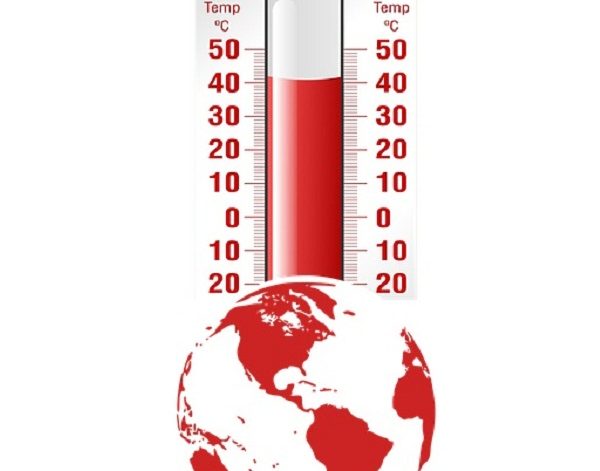
But the ecological pressures on these systems are proving harder and harder to disentangle from climate change. A systematic review of climate change and biodiversity in the Hindu Kush Himalaya concluded that climate change is now a key driver of biodiversity change in the region, with warming and changing rainfall creating ever increasing risks for ecosystems and the services they deliver. The review also highlighted a major gap: research has not been distributed evenly across ecosystems, with relatively less attention given to forests and wetlands.
This is especially important in Northern Pakistan because climate change doesn’t happen in a vacuum. Temperature changes can change the distribution of plants, effect flowering periods and change the height at which species can survive. Research in the valley has found that local communities in the Rakaposhi Valley in Gilgit-Baltistan have noticed changes in the distribution, abundance and flowering times of plants. The same study reported that 63 percent of respondents felt that some wild and domestic plants had disappeared from the study area, while others reported seeing species in the study area that had not been seen before.
Even more important is that the effects of change in ecology are not restricted to wildlife alone. The mountains in northern Pakistan are very important for the purposes of water security. Meltwater from the glaciers helps feed rivers and streams which are dependent on these glaciers. Biodiversity thus has a direct link with water as any change in ecology will have an impact on biodiversity and hence on soils and the watersheds, agriculture and settlements.
It is because of such initiatives that biodiversity conservation could end up being separate from the human communities around those ecosystems. The inhabitants in the mountain valleys have been relying on forests, rangelands, medicinal plants and other natural resources for a long time. Initiatives of conserving biodiversity without considering this interdependence will mean seeing these communities not as a partner but as a threat. It should be noted that there is some awareness regarding the benefits of community participation in conservation. For instance, community-based management, sustainable livelihoods, ecosystem services and effective community participation are mentioned as approaches to biodiversity and natural resource management in Gilgit-Baltistan.
The approach needs more attention. Biodiversity conservation cannot be achieved simply by setting aside protected areas. Gilgit-Baltistan already has national parks, wildlife sanctuaries, game reserves and even community-managed hunting areas. According to the government of Gilgit-Baltistan, some of the national parks include Central Karakoram, Khunjerab and Deosai while some of the game reserves are home to species such as ibex, snow leopard, brown bear among others. There are a number of advantages of having such protected areas; however, these protected areas are not enough to prevent habitat fragmentation and many other threats.
Perhaps, one of the greatest mistakes could be to consider that biodiversity is something that is only found within the confines of the national park systems and wildlife departments. Biodiversity is also found in forests around the villages, rangelands for pastoral communities, rivers running through valleys, medicinal plants from the mountains, and species that are dependent on fragile environments. Biodiversity is thus also related to food security, water security, livelihoods and resilience of mountain communities.
The biodiversity of Northern Pakistan does not require to be shown simply as an array of picturesque landscapes to be captured in photographs. The biodiversity requires to be appreciated as living infrastructure. Forests ensure that watershed functions properly, rangelands provide livelihoods, wildlife maintains ecological balance, and mountain ecosystems provide water systems even beyond the valleys from where they emerge. With ongoing climate change changing the conditions for these systems, conservation should progress from mere species protection to integrated landscape level planning, community involvement, scientific observation and climate change resilience.
Although the mountains may seem like immovable objects, the ecosystems in the mountains themselves are not. ‘’Although the changes taking place within these ecosystems may not be immediately apparent, they are still occurring at an ecological scale and are things that communities can now experience for themselves. As a result, biodiversity conservation in Northern Pakistan is more than just preserving wildlife’’.
Also Check Out: Unique Animal Species Biodiversity of Gilgit-Baltistan Pakistan
Choked by Trash: How Garbage Is Ruining Skardu Valley
Reference:
https://journal.kiu.edu.pk/index.php/JMAR/article/view/12
https://biking4biodiversity.org/the-special-connection-of-people-and-nature-in-gilgit-baltistan/
This article is contributed by:Sana Akbar is an Environmental Science graduate from PMAS-Arid Agriculture University, Rawalpindi. She has a keen interest in environmental science, sustainability, and climate-related issues. Her writing focuses on climate change, environmental challenges, and their impacts on Pakistan and the wider world.
We hope you all liked this post! Please, comment below if you have any suggestions, comments, or feedback! We #envpk love hearing from our readers! Thanks!