
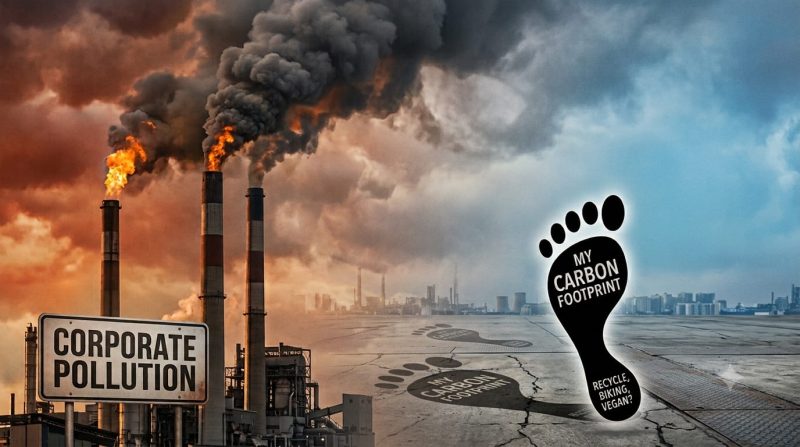
The Carbon Footprint Fallacy: Why the Public Bears the Blame for Corporate Pollution
The modern climate conversation often feels like a masterclass in guilt-tripping. We are told to carry canvas bags, swap plastic straws for soggy paper ones, sort our plastics into multi-colored bins, and feel immense personal shame if we leave a light on in an empty room. Meanwhile, just down the road, a single factory chimney might billow out more carbon emissions in an afternoon than an entire neighborhood produces in a year.This glaring disconnect raises an uncomfortable question: Why is the burden of saving the planet resting so heavily on ordinary citizens, while the world’s true climate culprits, behemoth corporations and passive governments frequently escape accountability?
The Illusion of Individual Impact
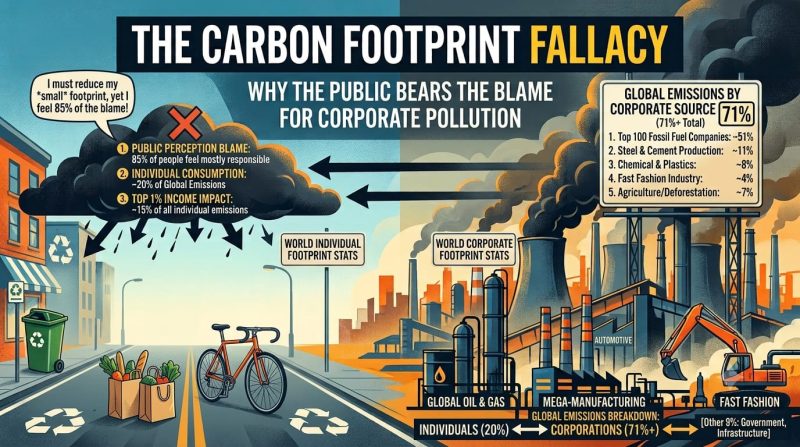
The hyper-fixation on personal responsibility isn’t an accident; it is a highly successful marketing strategy. The very concept of a “personal carbon footprint” was popularized in 2004 by the oil giant British Petroleum (BP) through a massive $100 million advertising campaign. By providing online calculators for individuals to measure their own environmental impact, the fossil fuel industry achieved a brilliant public relations pivot: they transformed a systemic global crisis into a matter of individual lifestyle choices.When the narrative is framed around whether “you” recycled a milk jug, the conversation shifts away from why that milk jug was made of virgin petrochemicals in the first place.
The math simply does not support this individualistic approach. Study after study confirms that a tiny handful of massive corporations are responsible for the vast majority of global greenhouse gas emissions. According to the groundbreaking Carbon Majors Report, just 100 fossil fuel producers have been linked to over 70% of the world’s industrial greenhouse gas emissions since 1988. No amount of shorter showers or vegan Mondays by ordinary citizens can offset that scale of industrial output.
Check Out: All You Need To Know About Carbon Footprint And Its Importance
Climate Change Crisis: Rethinking Carbon Accountability
Why Big Industries Get a Pass
Corporations have mastered the art of greenwashing , spending millions on advertising campaigns that feature lush forests and solar panels, while spending millions more lobbying behind closed doors to block environmental regulations. For decades, the primary objective of major industries has been the maximization of short-term shareholder value. Transitioning to truly sustainable practices, re-engineering supply chains, and abandoning cheap fossil fuels requires massive capital investment that threatens quarterly profit margins.
Furthermore, industries pass the buck by claiming they are merely supplying what the consumer demands. If people didn’t want plastic packaging or fast fashion, we wouldn’t make it, the argument goes. But this ignores the reality of choice architecture.
Average citizens do not choose to live in a society built entirely around fossil fuels or single-use plastics. They buy what is available, affordable, and accessible. When a sustainable product costs three times more than its plastic counterpart due to subsidized fossil fuels, choosing the eco-friendly option becomes a luxury rather than a standard civic duty. Industry creates the environment, and the citizen is forced to navigate it.
The Failure of Governance
This corporate deflection is only possible because governments allow it. In theory, governments exist to protect the public good, which includes a livable biosphere. In practice, regulatory capture and economic anxieties frequently paralyze legislative action.
Politicians operate on short election cycles, usually spanning two to five years, whereas the worst consequences of climate change operate on decades-long timelines. Passing sweeping, aggressive environmental legislation often means facing immense blowback from powerful industry lobbies, risking immediate job losses in traditional sectors, and weathering corporate threats to move manufacturing overseas.
Consequently, governments opt for the path of least resistance: voluntary corporate targets, distant net-zero by 2050 promises, and public awareness campaigns targeting the citizenry. By shifting the moral weight onto the voter, governments absolve themselves of the political risk required to pass hard laws, such as aggressive carbon taxes, strict bans on single-use plastics, or the immediate termination of fossil fuel subsidies.
Re-balancing the Scale
The point is not that personal actions are entirely worthless. Composting, reducing meat consumption and choosing public transit are noble, culturally vital practices that signal a societal desire for change. However, treating these actions as the solution to climate change is like trying to put out a forest fire with a squirt gun while someone behind you is pouring gasoline on the trees.
True environmental salvation will not be found in the supermarket aisle. It will only be achieved through systemic, structural overhauls that force industries to internalize the true cost of their pollution. Subsidize Solutions, Not Pollution: Governments must stop artificially lowering the price of oil and gas with taxpayer money and redirect those billions toward renewable energy infrastructure.
Extended Producer Responsibility (EPR): Laws must be enacted that make corporations financially responsible for the entire lifecycle of their products, including the cleanup and recycling of their packaging. If a company has to pay for the disposal of every plastic bottle it produces, it will find an alternative material overnight.
Aggressive Regulation over Incentives: Voluntary corporate pledges have failed. Governments must mandate strict emission caps and enforce heavy financial and legal penalties for non-compliance.
Until the legal and economic frameworks change, ordinary people will continue to carry the emotional and logistical weight of a crisis they did not create. It is time to stop asking citizens to fix a broken system from the inside out, and start demanding that the architects of that system repair it from the top down.
You Might Be Interested: What is Carbon Sequestration? – Techniques and Importance
Environment Smart Cities: Building the Future Sustainably
We hope you all liked this post! Please, comment below if you have any suggestions, comments, or feedback! We #envpk love hearing from our readers! Thanks!



1 Comment
Hello, I am a Yemeni researcher at Farid Khawaja University, currently working on a research topic focused on waste management. My research explores the potential of free and readily available artificial intelligence (AI). The title of my research is “Using Freely Available Generative AI Models (ChatGPT, Gemini, Meta AI) to Develop Creative Recycling Solutions for Solid Household Waste (A Comparative Pilot Study).” I have read your article, which is very important and contains valuable information. It is crucial to focus on tangible and realistic solutions that contribute to improving the disastrous situation of pollution and its risks. Attention should be given to integrating AI into pollution management in all its forms and studying the possibility of utilizing AI to propose and develop pollution solutions and treatments for factories, companies, organizations, and entities responsible for and working in the environmental field. I hope to connect with researchers and individuals interested in this field to exchange ideas and information and contribute to providing innovative solutions and effective treatments that reduce pollution and preserve the environment, resources, human well-being, and sustainability.