The Current Climate Reality
Climate change is not a distant threat but a present reality for Pakistan. This statement from the Pakistan Economic Survey 2025-26 is not just words—it is fact. The data shows that 2025 ranked as the country’s second warmest year in 65 years, with temperatures reaching 23.9°C and rainfall dropping 3 percent below average.
These figures are not abstract. They affect farmers watching their crops fail and unpredictable rainfall affects crop cycles and food security, families experiencing longer heatwaves, and mountain communities watching glaciers disappear and threatening water supplies and increasing the risk of glacial lake outburst floods. Pakistan contributes less than one percent of global emissions yet stands among the most vulnerable countries in the world.
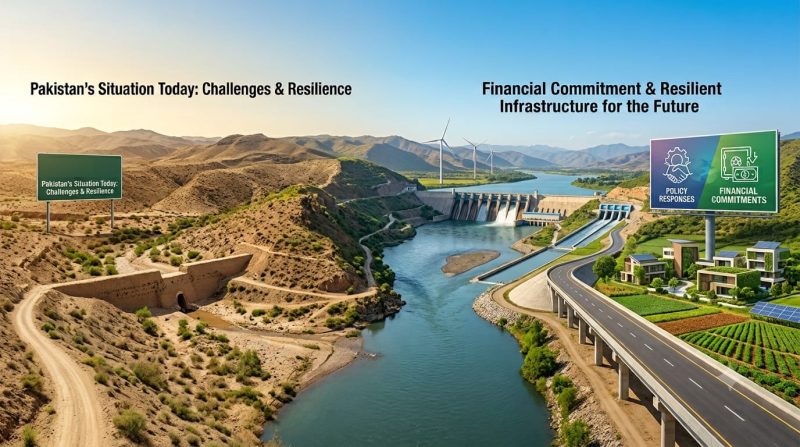
This brief examines where Pakistan stands today, what policy responses are underway, and what financial commitments have been made to build a more resilient future.
Policy Response and Institutional Framework
In response to these challenges, Pakistan has initiated a series of policy measures and institutional frameworks designed to address climate vulnerability while creating pathways for sustainable development.
- IMF Resilience and Sustainability Facility
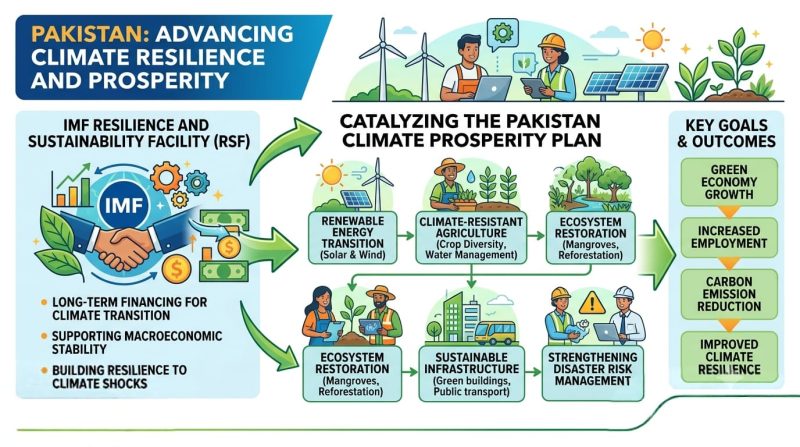
Pakistan has made measurable progress under the IMF Resilience and Sustainability Facility, with the completion of four key reforms. These include the introduction of a carbon levy, the adaptation of an electric vehicle policy framework, the issuance of climate-related financial risk management guidelines, and the operationalization of green taxonomy alongside ESG disclosure guidelines. These reforms collectively strengthen Pakistan’s capacity to manage climate risks while aligning the financial system with sustainability objectives.
- Pakistan Climate Prosperity Plan
The Pakistan Climate Prosperity Plan represents a flagship investment-led framework launched to transform climate challenges into opportunities for sustainable economic growth, resilience, and prosperity. Rather than treating climate action as a cost burden, this framework positions it as an investment opportunity capable of generating economic returns while building national resilience.
- Pakistan Green Taxonomy
The Pakistan Green Taxonomy is being implemented through a phased approach, beginning with voluntary reporting of climate-related risks, opportunities, and taxonomy-aligned activity data. This voluntary period extends until June 2029, after which a three-phase mandatory rollout will commence. The taxonomy provides clarity on what constitutes environmentally sustainable economic activity, enabling better investment decisions and facilitating access to international climate finance.
- Monsoon 2026 Strategic Plan
The approved Monsoon 2026 Strategic Plan constitutes a time-bound, anticipatory climate adaptation framework aimed at reducing recurrent flood-related losses. Taking a risk-informed approach, this plan focuses on preparation and proactive measures rather than reactive disaster response. It represents a significant shift in how Pakistan manages flood risks, with emphasis on identifying vulnerable regions and implementing targeted interventions before disasters occur.
- Climate and Disaster Resilience Enhancement Programme
The Climate and Disaster Resilience Enhancement Programme, Subprogram II, is currently under implementation with an allocation of US$500 million. This substantial investment reflects both the scale of the challenge and the commitment to building institutional and community capacity to withstand climate shocks.
- Glaciers to Farms Regional Programme
The Green Climate Fund Regional Programme Glaciers to Farms has been approved with an allocation of US$27.5 million. This initiative addresses the specific challenges faced by communities in glacier-dependent regions, where melting ice threatens water security and agricultural livelihoods.
Check Out: Green Multiplier: Powering Pakistan’s Economy without Taxing
Financial Commitments at a Glance
| Initiative | Allocation |
| Climate and Disaster Resilience Enhancement Programme (CDREP) – Subprogram II | US$ 500 million |
| Green Climate Fund Regional Programme Glaciers to Farms (G2F) | US$ 27.5 million |
| Total Commitments | US$ 527.5 million |
Summary of Climate Response
The following indicators provide a summary of Pakistan’s climate status and policy response:
- 2025: Second warmest year in 65 years with 23.9°C average temperature and 3% below average rainfall.
- IMF Resilience and Sustainability FacilityRSF: Progress with completion of four key reforms.
- Pakistan Climate Prosperity Plan: Climate investment blueprint launched.
- Pakistan Green Taxonomy: Issued and being implemented.
- Pakistan Monsoon 2026 Strategic Plan:Approved.
- Climate and Disaster Resilience Enhancement Programme (CDREP) Subprogram-II:Under implementation with allocation of US$500 million.
- Green Climate Fund Regional Programme G2F: Approved with allocation of US$27.5 million
Conclusion:
Pakistan’s climate journey reflects a growing recognition that environmental sustainability and economic development are not competing priorities but mutually reinforcing objectives. The policy frameworks and financial commitments outlined in the Economic Survey demonstrate institutional readiness to address climate challenges while pursuing growth.
However, the scale of investment required remains substantial, and implementation capacity will determine the effectiveness of these initiatives. Continued international cooperation, domestic resource mobilization, and sustained political commitment will be essential to translate these frameworks into tangible outcomes for communities across Pakistan.The path forward requires balancing immediate adaptation needs with long-term transformation, ensuring that climate action benefits all segments of society while building a more resilient and prosperous future for the nation.
Source: Pakistan Economic Survey 2025-26
Also Check Out: Environmental Politics and Climate Policy Critique
This article is contributed by:
Waqar Younas: PhD in Quantitative Methods in Economics, University of Macerata, Italy
Syed Yawar Ali: MPhil Environmental Economics, Pakistan Institute of Development Economics PIDE, Islamabad, Pakistan
We hope you all liked this post! Please, comment below if you have any suggestions, comments, or feedback! We #envpk love hearing from our readers! Thanks!