What are Coral Reefs?
Coral Reefs are large underwater structures and ecosystems that sprawl across the oceans and can frequently be found near coastal areas. They are hosts to approximately 25 million of aquatic flora and fauna in the oceans. Coral reefs are formed by colonies of individual coral polyps that are made up of calcium carbonate and can group together to expand.
Check out, Coral Reef Ecosystem of Pakistan- Climatic Biome
Formation:
Coral reefs are formed by invertebrates called polyps. This coral polyp is a single structure that can join together and form coral colonies known as coral reefs. Coral reef reproduce using asexual reproduction naturally.
Asexually, they are formed by the release of free roaming larvae released during the spawning or breeding time of the coral polyp. The spawning duration is usually 3 days some time around mid summer when water temperatures are not too cold neither too warm. These larvae later attach themselves to hard and free surfaces in the ocean floor or at the edges of the continent plate or Islands. From there they expand and grow inwards on the sea floor and form different types of coral reef.
Moreover, coral polyps have a symbiotic relationship with an algae that is capable of photosynthesis for the coral colony. It is called Zooxanthellae. This algae is also responsible for the vivid and diverse colors of the coral structures.
Function:
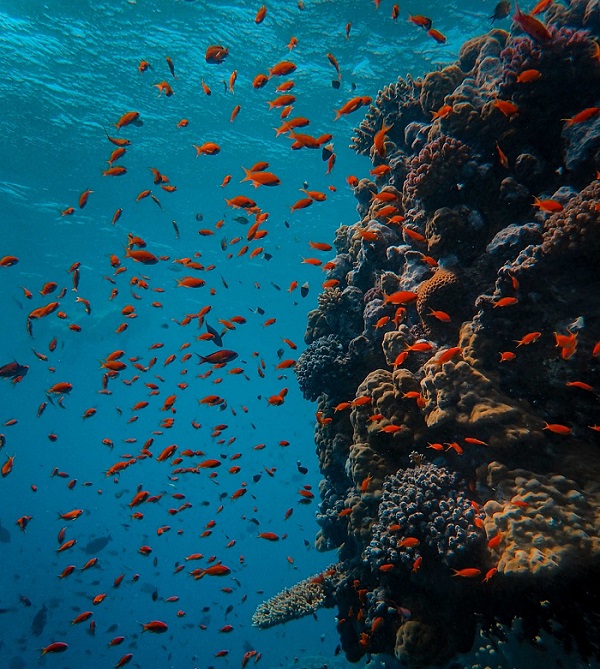
- Coral Reefs have the largest and highest biodiversity in the ocean. Although they cover less than 1% of the ocean floor they have 4000 species of fish dependent on it.
- It is a highly valuable ecosystem which benefits humans in more ways than one: Medicine, antibiotics and food is extracted from them annually by the scientists and local communities respectively.
- They protect coasts from storm surges , soil erosion, and many more benefits like food source for the local communities due to the biodiversity hosted by the coral reefs.
- They also offer recreational activities that promote tourism and boost the local economy like snorkeling, scuba diving etc.
Types of Coral Reefs:
There are generally two types of coral reefs; soft and hard coral.
Hard corals like Elkhorn and Staghorn corals have a skeleton made of calcium carbonate and thus are hard to touch.
Soft corals however, include sea fingers, sea whips that bear more similarity in structure to plants rather than hard structures.
Both types form colonies.
After their formation, the coral reefs expand and develop into one of the four types of coral reefs which are:
- Fringing Coral Reefs: these are the types that form around the edges of the continental plates or islands where land meets sea. They are separated from the coast lines by shallow lagoons. Lagoons are small water bodies that are separated from larger water bodies by a natural barrier in many cases which can be coral reefs or sometimes even a shallow sandbank. Fringing coral reefs are the most common type of coral reefs.
- Barrier Reefs: they form a barrier parallel to the coast line but are separated by deeper lagoons. They often show up in satellite images as they can be a hindrance to navigation efforts hence why they are named as “barrier”.
- Atolls: these are the coral reefs that arrange themselves naturally in a ring formation. They are usually found in the middle of the sea. They often surround a body of water like lagoons.
Often they may form when Islands with fringing reefs sink or are submerged by the rising water and the fringing reefs remain in place and stick out in the middle of the water. These are then termed as Atoll reefs. - Patch Reefs: these are coral reefs present in small patches throughout the ocean floor and are usually present between fringing and barrier reefs. They may be scattered like patches over a specified distance.
You may also be interested in, UAE-Israel Oil Pipeline Deal Can Destroy Red Sea Coral Reefs
Importance:
One entire single species among 8 million species are reliant on or are a part of the coral reef ecosystem for its healthy function, food source or key habitat maintenance. Coral reefs are largely threatened by climate change and approximately 40 million people across different communities are reliant on it for food, medicine and trade. A large chunk of marine biodiversity would be in grave danger if coral reef numbers continue to decline.
Thus, coral reef conservation by way of reducing global temperatures, ocean warming and acidification that disturbs the optimal conditions of the coral reef is very important.
Also check out, What Is Coral Gardening And Can It Help Save Coral Reefs?
and Coral Reef Destruction – Causes, Effects, and Solutions
I hope you all liked this post! Please comment below if you have any suggestions, comments, or feedback! We at #envpk love hearing from our readers! Thanks!