“The Earth is what we all have in common.” — Wendell Berry
Pakistan is blessed with some of the world’s most stunning natural landscapes, from the glaciers and alpine forests of the north to its rivers, wetlands, agricultural plains, deserts and coastline. But below this natural bounty is an environmental crisis that is increasingly difficult to ignore.
Damage to the environment is no longer just a problem of forests, wildlife or pollution. It is directly affecting human health, food security, water availability, livelihoods and community safety. Environmental destruction may exacerbate existing vulnerabilities and create new ones for a country already struggling with economic and social crises.
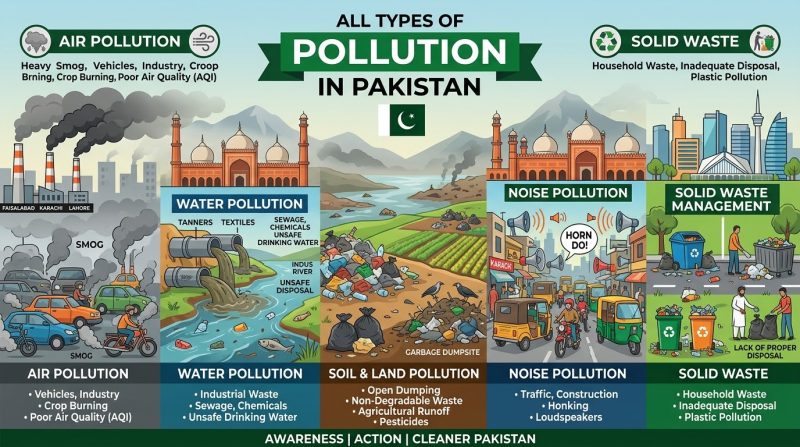
Environmental problems in Pakistan are interconnected. The natural resources are under tremendous pressure from rapid population growth, unplanned urbanization, deforestation, air and water pollution, and mounting climate risks. The results are seen in everyday life: polluted air in large cities, contaminated water sources, vanishing green areas, diminishing biodiversity and increasingly unpredictable weather.
Air pollution is one of the most visible environmental issues. Major urban centers often suffer from unhealthy levels of air pollution due to vehicle emissions, industrial activities, construction, crop-residue burning and poor urban planning. Poor air quality is not just an environmental problem anymore. It becomes a public health and an economic problem if people are exposed to polluted air for a long period of time.
One of the most harmful constituents of air pollution is fine particulate matter, especially PM2.5. Being microscopic, these tiny particles can penetrate into the deep sections of the respiratory tract and even into the bloodstream. Prolonged exposure to these particles has been linked to respiratory and cardiovascular diseases as well as other illnesses. Children, elderly persons, those working outdoors and those having respiratory illnesses can be especially vulnerable.
This is not all. Air pollution affects not only the health of people but the environment and economy of Pakistan. The pollutants emitted into the atmosphere can result in poor visibility, harm the vegetation and crops, affect the ecosystems and atmospheric processes. If the situation with the pollution worsens, then schools can limit outdoor exercises; there can be disruption in transport and those working outdoors can suffer from adverse environmental effects.
Check Out: Water Pollution Causing Antibiotic Resistance in Pakistan
What is causing Pakistan’s air pollution?
Sources of air pollution differ from one city to another, but transport is an important source of pollution. The proliferation of private vehicles, poorly tuned engines, congestion and continued use of old vehicles may lead to an increase in the levels of particulate matter and other pollutants. In urban areas with high density, thousands of vehicles moving on congested roads emit pollutants in an already stressed atmosphere.
Industry is another key source of air pollution. Industries, brick kiln operations, power generation and others may emit particulate matter and gases in the atmosphere without proper pollution control measures being in place or working efficiently. Expansion of industries is necessary for the economy but it must occur within the framework of proper regulation and monitoring of the environment.
Construction work is also contributing to air pollution in cities. Roads, buildings, and other building schemes lead to the production of dust particles. If the construction materials and soil are left exposed, the particulates are released into the atmosphere by vehicles. Improved construction practices and proper control of dust from roads can alleviate this problem.
A threat to public health
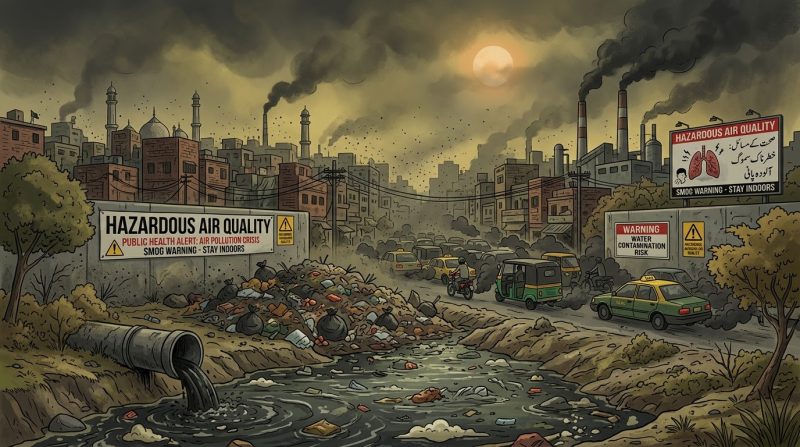
The worst impact of air pollution relates to the health of people. Everyone breathes a huge amount of air each day, which implies that the effect of polluted air can worsen the conditions of asthmatics and people suffering from some respiratory illnesses, being related to cardiovascular and respiratory diseases. Children need to be mentioned especially, as their lungs are still developing. Constant breathing of polluted air can prevent them from enjoying life and learning outside.
The economic aspect should also be considered, as the disease brings costs to patients and their families, as well as for governments and employers who must pay for the healthcare system, absence at work, and loss of productivity. Therefore, dealing with air pollution cannot only be seen as an environmental issue, but also as an investment in people’s development and productivity.
The way forward
As the air pollution issue of Pakistan is not caused by a single sector, it cannot be resolved by one body alone. The federal government, provincial governments, municipal corporations, industries, farmers, transport sector, academia and citizens all can play their parts.
There is need to move from reactive smog management approach towards proactive air quality management approach. Rather than wait until the level of pollution gets hazardous to take some measures, monitoring and implementation of environmental standards and investment in cleaner technologies need to be done continuously.
Air is a common property resource. Polluted air does not recognize the boundaries of provinces, social strata or economic classes. Though, the impacts might be different on different sectors of society, everyone ultimately requires the same polluted air.
The progress of Pakistan cannot come at the cost of denying people their rights to breathe in clean air. Through monitoring, enforcement, cleaner transportation, good industrial practices, efficient waste management and raising awareness, air pollution can definitely be decreased.
The task is very tough but the cost of negligence would certainly be much higher than that of taking necessary actions.
Also Check Out: Impact of Microplastic Pollution on the Environment
Reference:
https://www.iqair.com/air-quality/pakistan
https://www.jcpsp.pk/article-detail/pair-pollution-challenges-to-human-health-in-pakistanorp
https://dicf.unepgrid.ch/pakistan/pollution
This article is contributed by: Sana Akbar is an Environmental Science graduate from PMAS-Arid Agriculture University, Rawalpindi. She has a keen interest in environmental science, sustainability, and climate-related issues. Her writing focuses on climate change, environmental challenges, and their impacts on Pakistan and the wider world.
We hope you all liked this post! Please, comment below if you have any suggestions, comments, or feedback! We #envpk love hearing from our readers! Thanks!