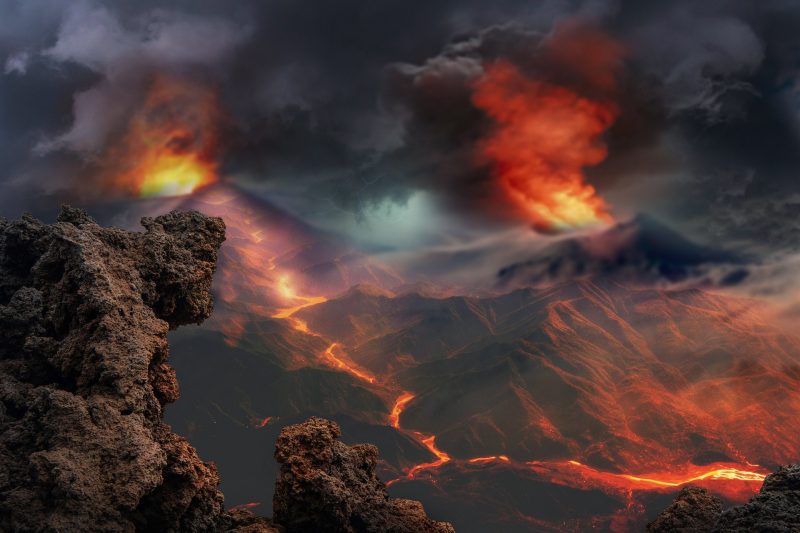
Volcanic Eruption : Any location on the surface of a planet where molten rock, gases, and pyroclastic debris erupt through the earth’s crust is referred to as a volcano. Volcanoes have a wide range of structural variations; some are craters where lava erupts from fractures in the earth’s crust, while others are domes, shields, or mountain-like formations with craters at their summits. Magma is molten rock found in the crust of the Earth. Lava is the term used when magma erupts through the surface of the earth. Lava can be either thick and move slowly, or thin and move quickly. Other types of rock, such as ash (finely powdered rock that resembles dark smoke issuing from the volcano), cinders (pieces of shattered lava) and pumice are also produced by volcanoes. The name “volcano” derives from Vulcan, the Roman god of fire. A Vulcano, an active volcano on the Italian Lipari Islands, legend said that Vulcan had a forge the vulcano where he could melt and form iron.
Read: We Are Witnessing Climate Change Kill Our World.
Cause of Volcanic Eruption :
- The earth is divided into three layers. The outer crust, on which humans reside, is thought to be 1800 miles thick. Then comes the mantle, followed by the core (inner and outer core).Molten rock and gases make up the mantle.Rock is an example of a solid material that has become liquid due to severe heat.
- Magma : Magma is the term for the molten rock and various gases found in the earth’s mantle.Oxygen, silicon, iron, aluminium, magnesium, and manganese are among the gases and crystal fragments that make up the liquid known as magma.They become magmatic igneous rocks when they cool on the surface of the earth. An eruption is usually the next thing to happen along fault lines, which are gaps or cracks where the earth’s crust is weak.
- Formation of Lava: Molten substances soon to be lava erupt to the surface through cracks in the crust.Lava fragments could shoot into the air during an eruption, creating massive lava clouds. Some also slowly flow from the vent, flooding the vicinity. Very small ash particles can potentially be released into the stratosphere and moved even further by wind. The estimated temperature of fresh lava is 2,200°F.
- Emergence of lava : When it first emerges from the vent, it may be red hot, and as it cools, it may turn grey or black. Like honey, silicon-rich lava pours from the vent much more slowly. Lava also exists in thick, pasty forms in other sorts.
Also Check out: What is a Healthy Environment? Why is it important?
Effects of Volcanic Eruption :Volcanoes can be extremely destructive, but unlike other natural disasters like floods, wildfires, and earthquakes, they can also have some beneficial impacts.
You might also be interested in: Increasing Natural Disasters due to Climate Change
Negative Effects :
- Lahars can arise when rain and melting snow combine with ash and muck. Lahars are mudflows that move very quickly.
- Eruptions that happen close to populated areas may spill and damage lives and property. Frequently, people need to be evacuated.
- Ash that is released very high into the stratosphere can harm the ozone layer. Natural scenery and landscapes can be ruined.
Also, check out: Bushfires and Their Dangerous Impacts on the Environment
Positive effects :
- Geothermal energy potential tends to be higher in areas near volcanic activity, which might be advantageous for towns and cities.
- Different kinds of erupting volcanoes offer spectacular landscape that is so lovely and natural that it draws visitors and has some economic benefit.
Management :
- Since volcanic eruptions can be dangerous, they must be managed. The following actions need to be considered:
- Stay inside since volcanic ash poses a health risk, especially if you suffer from a respiratory condition like asthma or bronchitis.
- Keep away from the identified restricted areas.
- When in the area of eruptions, always wear a helmet.
- Making ensuring the general populace is ready and aware of what to do prior to, during, and after an eruption.
- Establish logistics, evacuation routes, and centers
- broadcast information via radio, TV, or, if necessary, personal contact
- Sirens and drills should be used to evacuate the people.
- Teams for cleanup should be hired.
Also, check out 10 Initiatives Governments Need To Take To Control Climate Change and Environmental Degradation
We hope you all liked this post! Please, comment below if you have any suggestions, comments, or feedback! We #envpk love hearing from our readers! Thanks!