
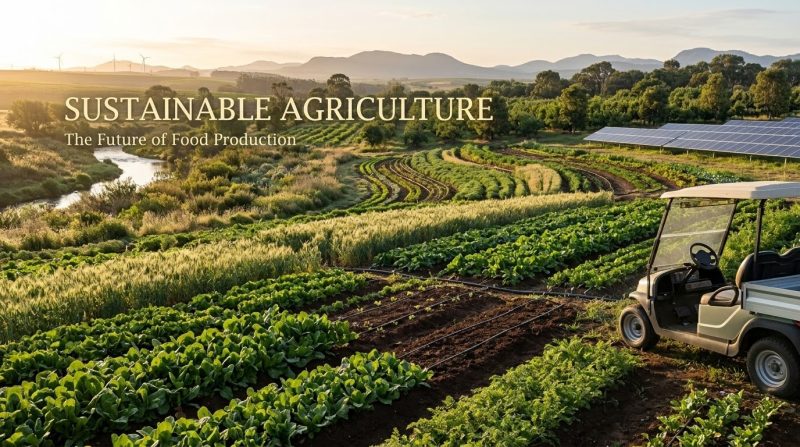
How climate-smart methods, precision technology and healthier soils can help secure food supplies while protecting the resources on which farming depends.
Feeding a Growing World Without Exhausting the Planet
Feeding the world’s growing population while preserving the soil, water, and biodiversity that agriculture depends onis a defining challenge for food production. Climate change, water scarcity, soil deterioration, and environmental pollution are putting increasing strain on farming systems. Overuse of chemical fertilizers, pesticides, and water can deteriorate soil health and environmental quality in some circumstances.
Sustainable agriculture offers a way forward. It seeks to provide a sufficient supply of healthful food while also protecting biodiversity, maintaining soil fertility, conserving natural resources, and maintaining farmers’ livelihoods. The goal is not only to boost productivity now but also to keep agricultural systems robust and fruitful for future generations.
Farming That Can Adapt to a Changing Climate
The goals of climate-smart agriculture are to lower greenhouse gas emissions, boost productivity, and assist farming systems in adapting to climate change. Particularly in nations where agriculture is a major source of income, rising temperatures, erratic rainfall, droughts, floods, and changing growing seasons can all have an impact on crop output and jeopardize food security.
Crop rotation, agroforestry, better soil management, and effective irrigation are among the useful tactics highlighted in a study by Kabato et al (2025). When used properly, these strategies can increase soil fertility, save water, and assist farmers in adapting to shifting weather patterns. However, limited funding, a lack of technical expertise, and inadequate training could prevent their implementation. Thus, government funding, research, and education are crucial components of the shift.
Check Out: Climate-Smart Agriculture: Pakistan’s New Contract with Nature
The Green Revolution 2.0: Cultivating a Sustainable Future
When Technology Helps Farmers Make Better Decisions
Precision agriculture uses technologies like GPS, drones, satellite images, soil sensors, and digital monitoring to more accurately manage crops and agricultural resources. Instead of applying the same amount of water or fertilizer to a whole region, farmers can make more targeted decisions by using information about crop and soil conditions.
Ruder et al. (2026) review found 54 studies having field-trial or modeling data out of 444 academic publications. Forty-five of the field-trial studies found environmental benefits, such as fewer greenhouse gas emissions, better soil quality, better water management, and less use of pesticides and fertilizers. For instance, digital monitoring can make it simpler to spot agricultural issues early, and smart irrigation can assist match water application to crop needs.
The potential of precision farming won’t be realized until the technology is accessible. Adoption may be difficult for small-scale farmers because of high costs, a lack of equipment, and a lack of technical know-how. It is essential to give these farmers access to affordable equipment, practical training, and support that is suitable for the local area in order to ensure that innovation doesn’t leave them behind.
Healthy Soil Is the Foundation of Food Security
Soil is more than just the space used to grow crops. Healthy soil facilitates long-term agricultural productivity, plant development, nutrient uptake, and water storage. Excessive plowing, deforestation, erosion, and poor land management can damage this resource and reduce its fertility.
The three interconnected principles of conservation agriculture are cropping variety, permanent soil cover, and minimal soil disturbance. By avoiding unnecessary plowing, keeping the soil covered to prevent erosion and moisture loss, and rotating or combining different crops, soil fertility can be maintained while reducing the risk of pests and diseases. Research given by Praharaj et al. (2025) emphasizes the significance of these behaviors for sustainable food systems.
The strategy is particularly useful when soil degradation and water scarcity pose a threat to farming. However, farmers may need the right tools, locally relevant guidance, and training before they can use it effectively.
A Wider Set of Practices for a Healthier Environment
Sustainable agriculture is not a single technique. Organic farming, agroforestry, agroecology, integrated pest management and conservation agriculture can all contribute to more responsible food production. Organic farming emphasises natural approaches to soil fertility and pest management. Agroforestry brings trees together with crops or livestock, while integrated pest management combines different methods to control pests and reduce unnecessary pesticide use.
Hiywotuet al. (2026) considers both the effectiveness and the trade-offs of sustainable agricultural practices. These methods can support soil health, water conservation and biodiversity, but they may also require investment, technical knowledge and changes to established farming routines. Their success depends on practical support, sound research and policies that reflect farmers’ circumstances.
“The future of food production depends on growing food while protecting the natural systems that make farming possible.”
Turning Good Ideas into Everyday Practice
Environmental and practical challenges confront sustainable farming. Soil deterioration, rising production costs, water scarcity, and climatic issues all have varying effects on farmers. Small-scale farmers may have limited access to modern equipment, money, training, and high-quality seeds. As a result, a successful transition must be affordable, practical, and customized to local needs.
Governments and agricultural groups can help by providing financial support, improving access to appropriate technologies, and raising farmer awareness. Research can assist produce climate-resilient agricultural varieties, efficient irrigation methods, better soil management strategies, and affordable equipment. Additionally, public awareness is crucial because it can boost support for sustainable systems through responsible consumption and a better comprehension of food production.
Progress requires cooperation between communities, legislators, researchers, and farmers. No single technology or farming method can solve every issue. Long-term results are more likely to be achieved with consistent assistance, trustworthy expertise, and locally relevant strategies.
A More Resilient Food Future
Sustainable agriculture is essential to the future of food production because it links productivity with the conservation of natural resources. Precision farming can improve input utilization, climate-smart agriculture can boost resilience, conservation agriculture may protect soil, and other environmentally friendly practices can reduce the burden on ecosystems.
Financial constraints, limited access to technology, and gaps in farmer understanding remain significant obstacles, but they can be addressed with research, education, supportive policies, and beneficial investment. The main goal is to develop farming methods that can feed people today without endangering the ability of future generations to survive.
Also Check Out: Sustainable Agriculture Practices and their Advantages
References
Kabato, W., Getnet, G. T., Sinore, T., Nemeth, A., & Molnár, Z. (2025). Towards climate-smart agriculture: Strategies for sustainable agricultural production, food security, and greenhouse gas reduction. Agronomy, 15(3), 565
Ruder, S.-L., Faxon, H. O., Orzel, E. C., Devkota, R., & Bronson, K. (2026). Reviewing the evidence on precision agriculture and environmental sustainability. npj Sustainable Agriculture, 4, Article 9.
Praharaj, S., Lal, B., Gouda, H. S., Pandey, A. K., Acharya, S., & Kumari, A. (2025). Conservation agriculture for sustainable food system: Current insights and emerging perspectives. Regional Sustainability, 6(5), 100264.
Hiywotu, A. M., Hibistu, A. G., & Molla, T. A. (2026). Sustainable agricultural practices and their environmental impacts: A structured review of effectiveness, trade-offs, and adoption barriers. Sustainable Futures, 11, 101877.
This article is contributed by: Afifa Ahmad Affiliation: BS Human Nutrition and Dietetics, Superior University, Lahore. Author Bio: Afifa Ahmad is a student of BS Human Nutrition and Dietetics at Superior University, Lahore. She is interested in nutrition, sustainable agriculture, food security, and environmental protection. She aims to create awareness about sustainable food production and healthy lifestyles through her writing. Thank you for your consideration. Best regards, Afifa Ahmad Author Information – Afifa Ahmad
We hope you all liked this post! Please, comment below if you have any suggestions, comments, or feedback! We #envpk love hearing from our readers! Thanks!