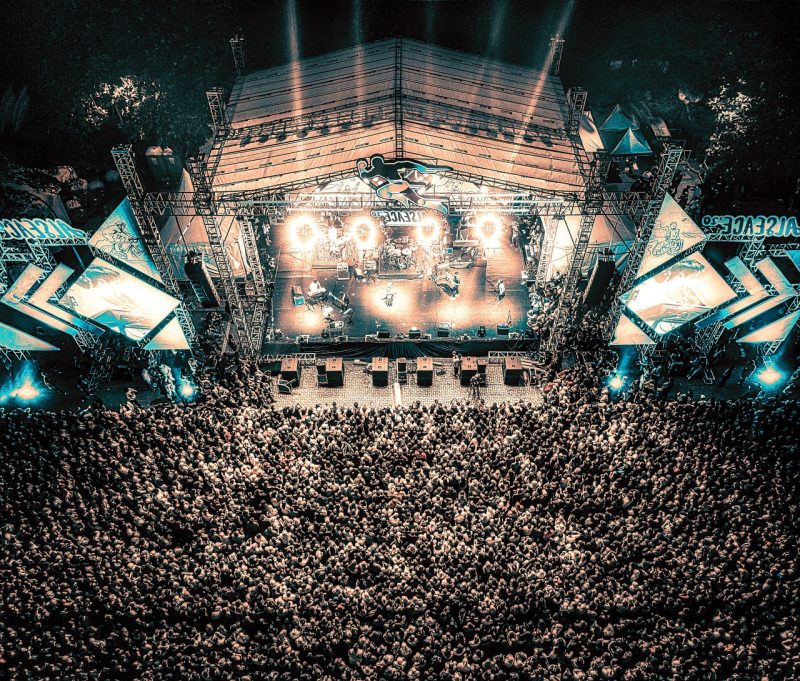
Music festivals like Coachella, or even just local musical gatherings once in a while are probably fine for some entertainment. However, it is the regular or frequent concerts in an enclosed dome or stadium that is of concern to the human health and environment. Where music gatherings vary from country to country it cannot be altogether banned or abstained from, since sometimes it is an important part of the culture. Therefore, while musical gatherings can be made more sustainable with considerably less noise, light and overall waste generation.
Negative Impacts of Music Festivals and Concerts on Environment:
It isn’t too far-fetched to say that musicians, singers and artists who go on tours leave behind a trail of huge environmental impacts on every city or place they stop. Sometimes these impacts are felt immediately while often they are long term and are observed much later. Some of these impacts are mentioned below:
Noise Pollution: This goes without saying since the very idea of a concert of musical gathering is of playing music and instruments as loud as possible, but this can prove to be detrimental especially in closed domes or higher walls designed to provide the best listening experience using acoustic enhancing materials in walls. This can lead to major hearing problems and overtime considerable loss of hearing in many individuals with age, Especially if they are regular concert goers. Apart from the loss of hearing, constant migraines, headaches, dizziness and claustrophobia and other health effects a person is highly likely to experience, concerts also have impacts on the environment:
Disturbing Circadian Rhythms: As most animals and birds are diurnal- sleep at night and wake up at dawn, there is a significant disruption in their diurnal and circadian rhythms which can interrupt with their behavior. Although many festivals and concerts are usually held in enclosed stadiums with soundproofing, however, not all are so. Many open air arenas and open festivals held in lush landscapes or in natural habitat do have the capacity to disturb wildlife and animal rhythms.

Carbon Footprint: Musicians who go on global tours for promotion and profit generation almost, have a massive environmental impact. Almost each and every aspect of touring leaves a large carbon footprint from flying in first class or worse private jets to transporting lights, equipment and other musical instruments from town to town. This leaves behind a large carbon footprint in every single city in a single night- sometimes more.
Energy Consumption: Strobe lights, LED lights, Flashlights or even stadium lights and all other manners of lighting used in concerts and festivals use incredibly large amounts of energy which further contributes to the tour’s carbon footprint. At an average, it is estimated that around 500,000 Watts of electricity is used in a single concert night. This also depends on the amount of stage lights and the scale of the concert or stage lights used. It equals to around 500 bulbs being used simultaneously.
Carbon Emissions: Gas, petrol etc, used in Singer tour buses or commuting to and from housing to concerts and festivals, not to mention the countless individuals who would further contribute to the GHG emissions for going to the concert venue. This cycle repeats in almost every city and it is not hard to imagine the impacts of it all repeated dozens of time in dozens of places.
Waste: Drinks, foods, merchandise wrappers, discarded cups, plastics and other single use products like armbands, posters, placards, napkins etc. to name a few examples of sources of waste that are littering the grounds of a concert venue are a common sight. The disposal problem and load aside, the impact of this in each and every city is astonishing with a single day’s waste generation exceeding that of a neighborhood’s weekly waste generation.
Also read: Controlling Air Pollution Crucial for Mitigating World’s Environmental Crises
Suggestions for Reducing Environmental Impacts of Concerts:
Although some popular eco-conscious musical groups have avoided going on tours for the sake of the environment however, it is always not a viable option for less popular bands or struggling artists.
Since the easiest way to generate revenue and make profit from their music is to go on tours that for a popular artists, generally spans across continents- It is responsible for bringing in a lot of money.
A research study showed that the tours of five musicians were tracked for how much carbon footprint they generate on a single tour. A carbon-tracking tool was used to measure their environmental impact. The research found that, combined, the artists added 19,314 kilograms of CO2 to the environment in only 6 months — which was equal to taking nearly twenty flights back and forth from New York City to London.
Some suggestions for artists would be to hold less concerts which is obviously not something that can happen easily since their income is at stake, However, there have been some eco-conscious groups that have refused to go on tour for the sake of environment. But this heavily relies of popularity and the ability to generate enough revenue from other sources alone. An option that is not given to less popular ones.
For concert goers however, there is an option to take public transport designated for the venue. This will reduce the carbon footprint by a considerable level.
Another suggestion could be to reduce the duration of a concert and the amount of lights used. Preferably to be held in daylight hours to save energy and also lessen the impacts of the noise generation and light pollution.
Conclusion:
Concerts and festivals are a prime part of many cultures and even a favorite past time for many people. So it is not possible for many reasons to altogether eliminate it. However, making conscious choices and providing alternative platforms for people instead of concerts can be considered as a sustainable effort.
Reference:
Brennan, M., Scott, J., Connelly, A., & Lawrence, G. (2019). Do music festival communities address environmental sustainability and how? A Scottish case study. Popular Music, 38(2), 252-275. doi:10.1017/S0261143019000035
You may also be interested in: Environmental Impacts Of The Film Industry
Fashion Industry and Its Negative Impacts on the Environment
Makeup Industry and Its Negative Impacts on the Environment
I hope you all liked this post! Please comment below if you have any suggestions, comments, or feedback! We at #envpk love hearing from our readers! Thanks!