
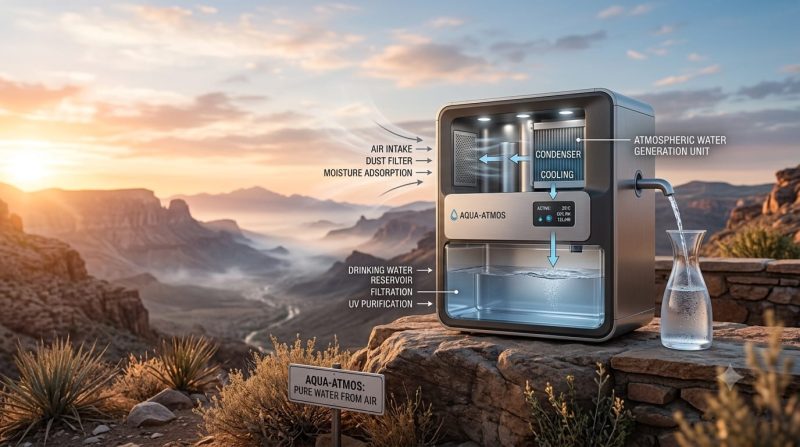
There is measurable water vapor in every cubic meter of air on the earth, even over deserts where the relative humidity can be less than 20 per cent. Atmospheric water harvesting (AWH) is the engineering discipline that focuses on capturing that vapor and turning it into potable water. What was a survivalist curiosity a generation ago is now a hot research field, spanning materials chemistry, thermodynamics and solar engineering, with peer-reviewed performance data to match.
The Thermodynamic Constraint
AWH depends fundamentally on the amount of Gibbs free energy required to separate water vapor from air, and this amount increases dramatically as humidity decreases. This limit was formalized in Energy & Environmental Science by Rao et al. (2022), who showed that at low relative humidity, the theoretical minimum energy input per liter of harvested water increases nonlinearly, explaining the historical poor performance of arid-zone harvesting relative to lab expectations. This one constraint dictates the technology path that makes sense for a given climate. This is the starting point for any serious technical evaluation of the field.
Two Engineering Pathways
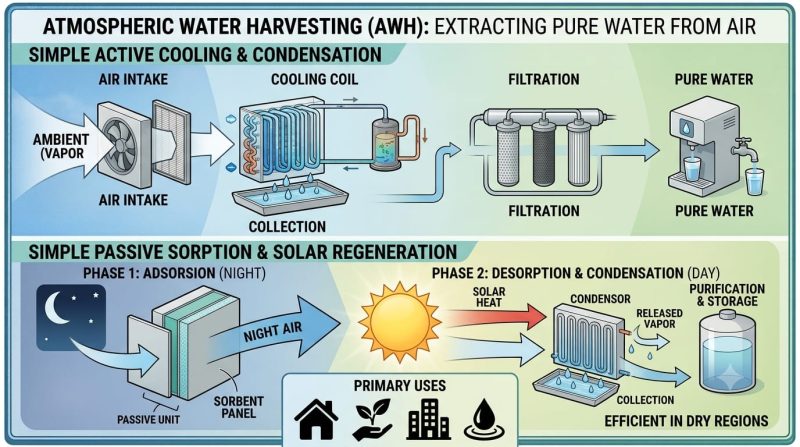
Most commercial deployments are still active, cooling-based systems. Air is drawn over a coil cooled by a refrigerant that condenses vapor as the air passes its dew point. It is mechanically the same as a dehumidifier with additional filtration and mineralization steps. These systems work well above about 40% relative humidity but rapidly degrade below this threshold because the energy cost per liter is inversely proportional to the ambient moisture content.
Sorption-based systems fill that gap with materials designed to grab water at low humidity. Metal-organic frameworks (MOFs) – crystalline, porous coordination polymers with huge internal surface area – can absorb water vapor directly from air as dry as 10-20% relative humidity, then release it as a liquid when heated. A dual-stage MOF harvester that thermally decoupled the sorption and condensation steps was developed by LaPotin et al. (2021) in Joule, achieving water performance comparable to single-stage designs but with a smaller device footprint – an important step toward scalable solar-driven production.
At the same time polymer chemists have been developing more manufacture, cheaper sorbents. Guo et al. (2022) in Nature Communications demonstrated a scalable hygroscopic polymer film that can perform moisture harvesting continuously in arid environments without the synthesis complexity of crystalline MOFs but rather a design choice based on cost and manufacturability rather than maximum efficiency. This trade-off between material performance and the scalability of production is today the main open issue in sorption-based AWH.
From Vapor to Verified Potable Water
No matter what the capture mechanism is, a working unit has a similar architecture: filtered air intake, moisture capture (cooling or adsorption), a heat-driven desorption and condensation step for sorption systems, multi-stage filtration (activated carbon, UV, or reverse osmosis), and final demineralization, because condensate is functionally distilled water and needs re-introduced calcium and magnesium for both taste and safety. Several studies have compared the thermal and electrical desorption routes and have shown that the thermal regeneration of sorbents is more efficient than the electrical regeneration using photovoltaic-driven refrigeration.
What the Field-Scale Data Actually Shows
In a paper in Nature, Lord et al. (2021) modeled the potential for global deployment and estimated that based on data on regional humidity and solar irradiance, not speculation, atmospheric harvesters powered by solar could theoretically provide drinking water to about a billion people who currently lack reliable access. That modeling has been paired with actual deployments since: containerized, solar-augmented units have been piloted in refugee camps and remote installations throughout parts of the Middle East, sub-Saharan Africa and South Asia, with reported daily outputs ranging from hundreds to low thousands of liters per unit.
The military and defense research have independently demonstrated the sorption approach under field constraints. The DARPA Atmospheric Water Extraction program has backed portable systems, including one from General Electric that plans to supply some 150 soldiers with equipment that can be carried by four people — a design constraint that has pushed sorbent and heat-exchanger efficiency far beyond early commercial units.
Check Out: What is Rainwater Harvesting? Importance and Techniques
The Environmental Ledger
Any blanket sustainability claim based on life-cycle analysis has complications. Peters, Blackburn, and Armedion (2013) found that the environmental footprint of AWH is determined overwhelmingly by the source of electricity rather than the harvesting mechanism itself (grid-powered, coal-dependent condensation units can have a carbon cost per liter orders of magnitude greater than reverse-osmosis desalination while solar-thermal-regenerated sorption systems can have near-zero operational emissions). That is no small caveat; it is the variable that determines whether a given deployment is environmentally net-positive at all.
Where the Research Is Heading
The unanswered technical questions are specific and tractable: reducing the synthesis energy and cost of MOF sorbents, extending sorbent cycle life under repeated adsorption-desorption loading, and characterizing any microclimate effects of humidity extraction at genuinely large deployment scale—a question current research has flagged but not yet answered empirically. These are not fundamental physics barriers; they are materials-engineering and systems-integration problems, the same class of challenge that has driven down solar photovoltaic costs by an order of magnitude over two decades.
Atmospheric water harvesting is no longer science fiction. It is a maturing peer-reviewed field that is turning a well-understood thermodynamic principle into deployable infrastructure, one liter, and one research paper at a time.
Also Check Out: What is Rain Gardening? – What are its types and benefits?
References
- Rao, A. K., Fix, A. J., Yang, Y. C., &Warsinger, D. M. (2022). Thermodynamic limits of atmospheric water harvesting. Energy & Environmental Science, 15(10), 4025–4037.
- Lord, J., Thomas, A., Treat, N., et al. (2021). Global potential for harvesting drinking water from air using solar energy. Nature, 598(7882), 611–617.
- LaPotin, A., Zhong, Y., Zhang, L., et al. (2021). Dual-Stage Atmospheric Water Harvesting Device for Scalable Solar-Driven Water Production. Joule, 5(1), 166–182.
- Guo, Y., Guan, W., Lei, C., Lu, H., Shi, W., & Yu, G. (2022). Scalable super hygroscopic polymer films for sustainable moisture harvesting in arid environments. Nature Communications, 13, 2761.
- Peters, G. M., Blackburn, N. J., &Armedion, M. (2013). Environmental assessment of air to water machines — triangulation to manage scope uncertainty. The International Journal of Life Cycle Assessment, 18(5), 1149–1157.
- Tucker, P. (2021, February 8). The Military Wants To Produce Water From Air. Here’s the Science Behind It. Defe
We hope you all liked this post! Please, comment below if you have any suggestions, comments, or feedback! We #envpk love hearing from our readers! Thanks!
This article is contributed by: Engr khawar Shoaib
Chemical Engineer
MS Scholar Climate change and Env Sci
NUtech Islamabad
0302.5459541


1 Comment
An insightful and thought-provoking article! “From Sky to Cup” beautifully highlights the connection between our environment and everyday life. A great read for anyone interested in environmental sustainability.