Exploring the Mysterious World of the Ghosts of the High Peaks With 10 Fascinating Facts About Himalayan Snow Leopard.
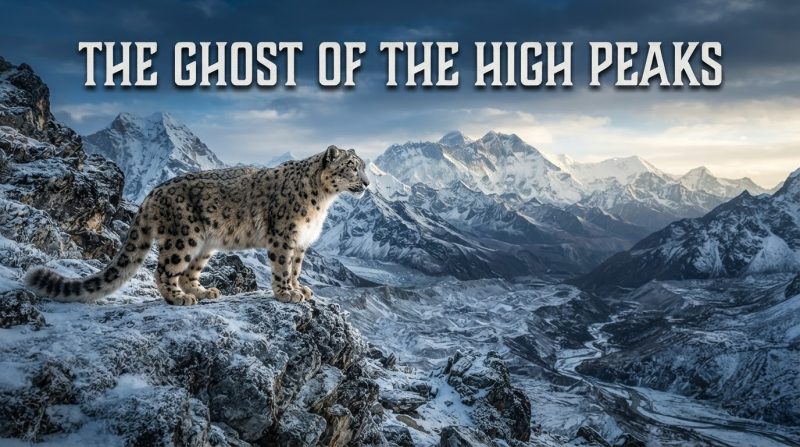
Revered across the towering mountain ranges of Asia as the “ghost of the peaks,” the Himalayan snow leopard (Panthera uncia) stands among the planet’s most elusive and fascinating apex predators. Roaming the jagged, snow-blanketed cliffs of the Himalayas and neighboring Central and South Asian ranges, stretching across Pakistan, India, Nepal, Bhutan, and China, this remarkable feline has mastered life at extreme altitudes between 3,000 and 5,000 meters above sea level.
Engineered by evolution to endure sub-zero winds and sheer rocky precipices, the snow leopard is a marvel of high-altitude adaptation. Its dense, smoky-gray fur, accented with dark rosettes and spots, blends effortlessly into scree slopes and snowdrifts, rendering the cat virtually invisible to prey and researchers alike. Operating primarily as solitary hunters during twilight hours, they quietly navigate steep ravines in pursuit of blue sheep (bharal), Siberian ibex, and Himalayan marmots.
Beyond their striking appearance and agility, Himalayan snow leopards serve as a vital barometer for the health of alpine ecosystems. By keeping wild herbivore numbers in balance, they prevent overgrazing and protect delicate mountain flora that supports numerous other species. Yet, despite their natural resilience, these mountain monarchs face mounting pressures from a warming climate, shrinking habitats, illegal wildlife trade, and retaliatory killings by local herders defending their flocks. Classified as Vulnerable on the IUCN Red List with an estimated wild population between 4,000 and 6,500 individuals, conserving the Himalayan snow leopard is essential not just for preserving a rare big cat, but for protecting the fragile high-altitude watersheds that sustain millions of people downstream.
Check Out: Why Northern Pakistan’s Biodiversity Needs More Than Protection
Top 10 Fascinating Facts About Himalayan Snow Leopards:
- Inability to Roar: Unlike lions, tigers, leopards, and jaguars, snow leopards lack the specialized vocal apparatus needed to produce a roar. Instead, they express themselves through mews, low growls, haunting yowls, and a gentle, friendly snort known as chuffing.
- Closer Cousins to Tigers: Although they share a name with true leopards, genetic mapping confirms that snow leopards are evolutionarily much closer to tigers.
- Natural Fur Snowshoes: Their broad, oversized paws are heavily padded with thick fur, distributing their body weight across soft snowdrifts while insulating their feet against frostbite.
- A Multi-Purpose Tail: Growing up to 105 centimeters (more than 3 feet) in length—almost matching their body length—their plush tail acts as a rudder for balance on narrow ledges and doubles as a warm blanket wrapped around their muzzle during rest.
- Unmatched Leaping Power: With shorter front legs and muscular, elongated hind limbs, snow leopards can launch themselves horizontally across 9 to 15 meters (30 to 50 feet) in one bound—nearly six times their own body length.
- Built-In Air Warmers: Their compact snout and expanded nasal passages act like natural heat exchangers, warming frigid, thin mountain air before it enters their lungs.
- Pound-for-Pound Powerhouses: Weighing between 35 and 55 kilograms (77 to 121 pounds), these predators are strong enough to subdue prey up to triple their own body mass, including full-grown ibex and argali sheep.
- Endurance Mountain Trekkers: Roaming vast, rugged territories alone, a single snow leopard can cover up to 40 kilometers (25 miles) over steep terrain in just one night.
- Peaceful Toward People: Despite their formidable hunting skills, there has never been a confirmed fatal snow leopard attack on a human; they are deeply reclusive and consistently choose retreat over confrontation.
- Densest Coat Among Wild Cats: To insulate against brutal alpine winters, the fur on a snow leopard’s underbelly reaches nearly 12 centimeters (5 inches) in thickness—making it the heaviest, densest coat in the entire feline family.
Also Check Out: Unique Animal Species Biodiversity of Gilgit-Baltistan Pakistan
We hope you all liked this post! Please, comment below if you have any suggestions, comments, or feedback! We #envpk love hearing from our readers! Thanks!