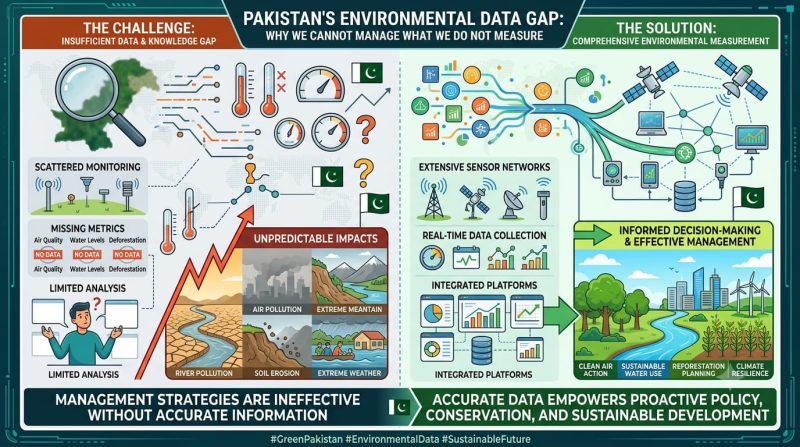
Pakistan has no shortage of environmental problems. Air pollution affects major cities, water resources are under increasing pressure, ecosystems are changing, waste is accumulating, and climate-related hazards are placing growing demands on communities, agriculture and infrastructure. Yet behind many of these challenges is another problem that receives far less attention: Pakistan’s ability to collect, connect and use reliable environmental information.
Environmental policy begins with knowledge. Before authorities can effectively control pollution, protect water resources, conserve ecosystems or prepare communities for environmental risks, they need to understand what is changing, where it is changing, how quickly it is happening and who is most affected. Without reliable and timely information, environmental management can become reactive rather than preventive.
The issue is not that Pakistan has no environmental data. Several institutions already collect important information. The Pakistan Meteorological Department maintains extensive meteorological and climate records, while the Pakistan Environmental Protection Agency conducts environmental monitoring and laboratory analysis covering areas such as air, water and soil. The challenge is ensuring that these different sources of information are sufficiently connected, consistent, accessible and useful for decision-making.
The Data Problem Behind the Environmental Problem
Pakistan’s environmental information is generated by federal and provincial departments, universities, research organizations, laboratories and other institutions. Each plays an important role, but environmental problems rarely fit neatly within institutional or administrative boundaries.
Air pollution, for example, is influenced by transport, industry, weather, urban development and seasonal conditions. Water quality can be affected by sewage, industrial discharge, agriculture, groundwater extraction and population growth. Land-use changes can influence flooding, groundwater recharge, biodiversity and urban temperatures.
When information about these factors exists in separate systems, decision-makers may see individual pieces of an environmental problem without seeing the complete picture.
Pakistan’s recent climate reporting recognizes several related challenges. These include limited meteorological coverage in some high-altitude areas, gaps in historical climate records, insufficient local-scale climate information and weak integration between research and policymaking. The report recommends expanding monitoring networks, digitizing historical records, integrating satellite-based information and improving access to climate data for researchers and policymakers.
This demonstrates that the environmental data challenge is not simply about collecting more information. It is about building a system in which existing and newly collected information can work together.
Check Out: Lack of Climate Change Research in Pakistan – Need and Importance
Why Local Environmental Data Matters
National averages can hide important local realities.
Pakistan is geographically and environmentally diverse. The challenges faced by a coastal community in Sindh may be very different from those experienced by farmers in Punjab, communities in the mountainous north or populations living in the arid regions of Balochistan.
A national rainfall average cannot fully explain drought conditions in a particular district. A national air-quality figure cannot show which neighborhoods within a city are experiencing the greatest exposure. Similarly, national water statistics may not reveal the specific pressures facing a particular watershed or groundwater-dependent community.
Environmental information therefore needs to become more local.District-level and city-level monitoring could help authorities understand changes in air quality, water quality, groundwater, rainfall, temperature, land use, vegetation and waste generation. Such information could allow local governments to identify emerging problems earlier and prioritize interventions according to actual environmental conditions.
This is particularly important because environmental risks are experienced locally, even when their causes or consequences are national.
Measuring More Than Climate
Environmental data is sometimes discussed almost entirely in terms of weather and climate. Climate information is certainly essential, but environmental monitoring needs to be much broader.
Pakistan needs reliable information about air pollution, water quality, groundwater levels, soil conditions, biodiversity, forests, wetlands, land-use change and waste, among other indicators.
The Pakistan Environmental Protection Agency’s Central Laboratory for Environmental Analysis and Networking, for example, has facilities for analyzing air, water and soil and conducts environmental investigations and monitoring. The agency also publishes ambient air-quality information. These are important foundations for environmental governance.
The next challenge is to ensure that information generated through such monitoring is consistently collected, maintained, compared and translated into practical decisions.
Data Quality Matters as Much as Data Quantity
Collecting large amounts of environmental information does not automatically produce better environmental policy.Data needs to be accurate, consistent and comparable. Monitoring equipment needs appropriate calibration, sampling procedures need to follow reliable standards, and results need to be properly documented.
If two institutions measure the same environmental indicator using different methods, comparing their results may become difficult. Developing compatible monitoring standards would make information from different provinces and institutions much more useful.
Data quality is especially important when environmental information is used to influence public-health decisions, industrial regulation, infrastructure development or environmental enforcement.
The objective should therefore be better data, not simply more data.
The Value of Historical Environmental Records
Environmental change cannot always be understood through observations collected over only a few years.Long-term records allow researchers to identify gradual changes, unusual events and emerging trends. Historical rainfall, temperature, water-quality, land-use and biodiversity records can provide valuable context for understanding present conditions.
Pakistan’s climate-data system already maintains extensive historical information. The Climate Data Processing Centre of the Pakistan Meteorological Department was established to store, process, retrieve and provide climatological and meteorological information to users. Its data has applications ranging from agriculture and water management to health, forestry, construction and transport.
However, Pakistan’s recent national climate reporting has also identified gaps in historical records and the need for greater digitization and consolidation.Preserving and digitizing these records should therefore be considered an environmental priority. Information collected decades ago may become increasingly valuable as Pakistan attempts to understand long-term environmental change.
Technology Can Transform Environmental Monitoring
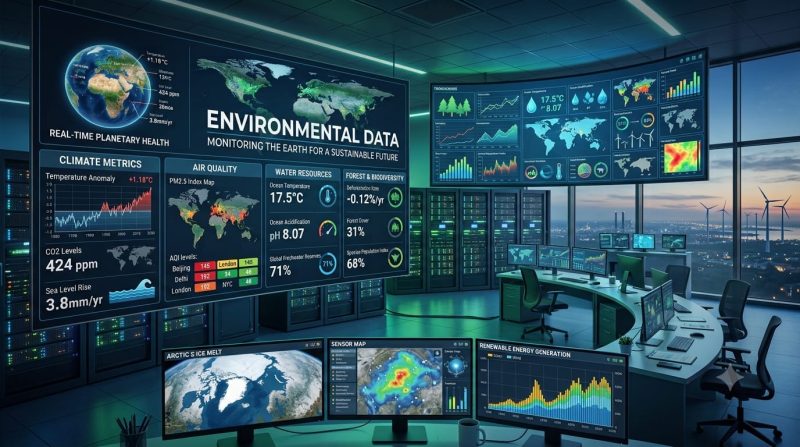
Pakistan also has an opportunity to use modern technology to strengthen environmental observation.Satellite imagery, geographic information systems, remote sensing, automated weather stations and environmental sensors can provide information across large areas and at much greater frequency than traditional monitoring alone.
Satellite observations can help track changes in vegetation, water bodies, forests, agricultural land and urban expansion. Geographic information systems can combine environmental information with population, infrastructure and socioeconomic data to identify areas where environmental risks and human vulnerability overlap.
Artificial intelligence and machine-learning systems could eventually help analyse these large datasets and identify patterns associated with floods, droughts, heat, pollution or ecosystem degradation.
But technology should not be treated as a replacement for field-based science. A sophisticated analytical system cannot compensate for poor-quality or incomplete information. Technology works best when combined with reliable ground observations, trained professionals and strong quality-control procedures.
From Environmental Data to Public Health
The importance of environmental information extends directly into public health.Air pollution, contaminated water, extreme heat and environmental degradation can all create risks for communities. Better environmental monitoring can help authorities identify areas where environmental exposure may be particularly severe.
Air-quality information, for example, becomes more useful when it can be examined alongside information about traffic, industrial activity, weather and population exposure. Water-quality information becomes more valuable when connected with information about potential contamination sources and communities relying on that water.
This does not mean that environmental data should compromise personal privacy. Rather, appropriately managed and aggregated information can help policymakers understand where environmental risks are concentrated and where interventions are most urgently required.
Better Data for Agriculture and Water Security
Agriculture is another area where environmental information can make a significant difference.
Farmers and agricultural planners depend on information about rainfall, temperature, soil conditions, water availability and changing weather patterns. Better local information can support decisions about planting, irrigation and crop management.
Water managers similarly require information about rainfall, river flows, groundwater and demand. As Pakistan faces increasing pressure on its water resources, decisions based on incomplete information can become increasingly costly.
Environmental data should therefore be treated as part of Pakistan’s food and water security infrastructure rather than simply as a research resource.
Making Environmental Information Accessible
Another important question is who can access environmental information.Environmental data should not remain confined to technical reports or institutional archives. Where information is not sensitive, it should be made easier for researchers, universities, journalists, communities and citizens to access and understand.
Public access can strengthen accountability. Researchers can identify knowledge gaps, universities can develop new studies, journalists can investigate environmental problems and communities can better understand the risks affecting them.
Pakistan could benefit from a national environmental information platform bringing together verified information from relevant institutions. Such a platform could include environmental indicators, maps, monitoring results, datasets and reports while allowing sensitive information to remain appropriately protected.The objective should be to make reliable information understandable as well as available.
Connecting Research with Policy
Pakistan has scientists, universities, laboratories and government institutions conducting valuable environmental research. The challenge is ensuring that research findings are translated into policy and implementation.
A scientific study is valuable, but its impact becomes much greater when its findings influence planning, regulation, investment or community action.
Pakistan’s recent climate reporting identifies weak integration between climate research and policy as an important challenge. Strengthening the connection between researchers and decision-makers could help ensure that environmental policies are based on current evidence rather than assumptions or outdated information.
Regular dialogue between government agencies, universities, scientists and local stakeholders could help bridge this gap.
Building a National Environmental Data Framework
Pakistan does not necessarily need a single institution to control all environmental information. A more practical approach would be to develop a coordinated framework through which federal and provincial institutions can share compatible information while maintaining their respective responsibilities.
Such a framework could establish common standards for monitoring, data management and reporting. It could also clarify responsibilities for collecting, maintaining and updating different types of environmental information.
A national environmental data portal could become part of this system, allowing verified information from different sources to be brought together in one accessible platform.
This would help move Pakistan from fragmented environmental measurements toward a more integrated understanding of environmental change.
From Data Collection to Environmental Intelligence
The ultimate goal should not be to collect data simply for the sake of having more information.
Data becomes valuable when it changes decisions.Reliable environmental information can help authorities identify pollution sources, anticipate risks, target investments, protect vulnerable communities, evaluate environmental policies and measure whether interventions are actually working.
This is particularly important as Pakistan faces increasingly complex environmental pressures. Floods, droughts, heat, water scarcity, pollution and ecosystem degradation are interconnected challenges. Understanding one without considering the others can lead to incomplete solutions.
Environmental monitoring should therefore evolve from simply recording what has happened toward helping policymakers understand what may happen next.
Building an Evidence-Based Environmental Culture
Pakistan already has many of the foundations required for stronger environmental information: scientific institutions, monitoring facilities, laboratories, climate records, universities, technical professionals and increasingly accessible digital technologies.
The challenge is to connect these strengths.Environmental problems will not disappear simply because more information is collected. But better information can help Pakistan decide where action is needed, what interventions are most appropriate and whether those interventions are producing results.
The country therefore needs to move toward an environmental culture in which evidence is treated as an essential part of decision-making.
The question is not simply whether Pakistan has environmental data. The more important questions are whether that data is reliable, connected, sufficiently local, accessible to those who need it and translated into action.
Environmental governance ultimately depends on knowledge.
Pakistan cannot effectively manage its air, water, land and ecosystems without understanding how they are changing. Measuring better, sharing responsibly and turning evidence into action can help the country move from reacting to environmental problems toward anticipating and addressing them.
Also Check Out: Environment Smart Cities: Building the Future Sustainably
References
- Pakistan Meteorological Department. Climate Data Processing Centre (CDPC) — Climate Data and Services.
- Pakistan Environmental Protection Agency, Ministry of Climate Change & Environmental Coordination. Central Laboratory for Environmental Analysis and Networking (CLEAN) and Environmental Monitoring.
- Pakistan Environmental Protection Agency. Ambient Air Quality Data and Environmental Publications.
- Government of Pakistan. Pakistan’s Third National Communication on Climate Change, 2025.
- Government of Pakistan. Pakistan’s Biennial Transparency Report (BTR), submitted under the United Nations Framework Convention on Climate Change.
- Ministry of Climate Change & Environmental Coordination, Government of Pakistan. Year Book 2022–23.
- World Bank. Pakistan Environmental Sustainability: A Pathway to Clean Growth, Pakistan Environmental Assessment.
We hope you all liked this post! Please, comment below if you have any suggestions, comments, or feedback! We #envpk love hearing from our readers! Thanks!
This article is contributed by: Noreen Raza is a civil servant ,served as Forest Officer with a professional degree from the Pakistan Forest Institute (PFI) and currently serveing as Assistant Director (Tech) at the Sindh Environmental Protection Agency (SEPA) in Environment, Climate Change & Coastal Development. She is an IUCN CEESP member, UNITAR and PFI alumna, ISO 14001/45001 certified, and an advocate for climate and biodiversity. Noreen regularly writes and speaks on environmental issues, with publications in English and Arabic internationally.