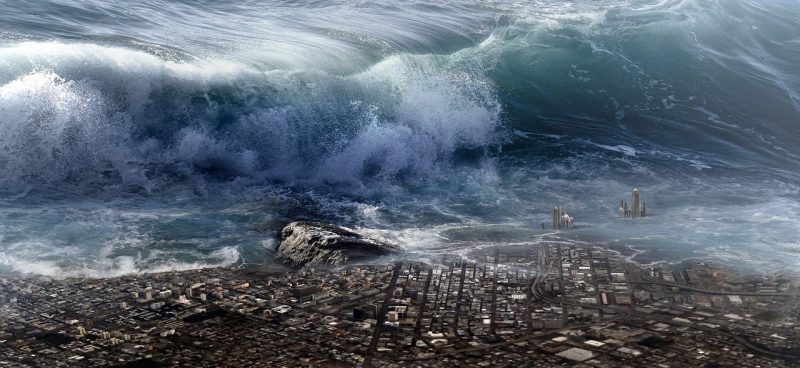
The English equivalent of the Japanese word tsunami is tsunami. harbour wave Two characters are used to represent this: the top character, “su,” stands for harbour, and the bottom character, “nami,” for wave. In the past, the general people occasionally referred to tsunamis as “tidal waves.” defined by the scientific community as “seismic sea waves.”
Characteristics of Tsunami:
The characteristics of tsunami are as follow:
- A tsunami can travel hundreds of kilometres across the deep ocean at speeds of roughly 725 to 800 km/h, with wavelengths of 100 to 200 km.
- Due to the size of the water involved and the pace at which they move, tsunamis have a powerful force. A metre of water alone weights one tonne.
Also read: Soil Erosion and Degradation – Causes, Effects, and Solutions
Causes of Tsunami :
The causes of tsunami are as follow:
Earthquake: There are three main geological processes that result in tsunamis. The majority of these involve earthquakes and fault movements on the ocean floor. They have the ability to cross seas and discharge enormous amounts of energy. Depending on how quickly the earthquake happens and how much water is moved, there will be varying degrees of movement.
Landslides: A landslide that occurs underwater or that begins above the sea before falling into the water is the second most frequent reason for tsunamis. Lituya Bay, Alaska experienced the greatest tsunami ever caused by a landslide in 1958. The enormous rock slide caused a wave to form that rose 50–150 metres over the coastline.
Volcanic Activity : Volcanic activity is the tsunami’s third main cause. A volcano that is submerged or close to the shore may have its flank uplifted or depressed in a fault-like manner, or it may even erupt. The famed Indonesian volcano Krakotoa violently erupted in 1883, unleashing a 40-meter-high tsunami that ploughed onto Java and Sumatra. The tyrant waves claimed the lives of around 36,000 people.
For more information: Landslides and Rockfall – Causes, Effects, and Prevention
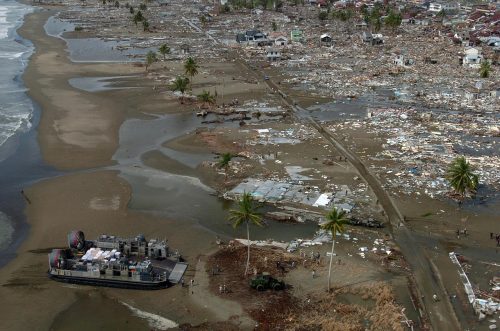
Effects of Tsunami:
Because the fast-moving waves will impact land so suddenly, damage is frequently worse in regions that are closest to the underwater quake. Tsunamis spread from an undersea quake’s epicenter almost as quickly as a jet plane can fly, but due to the Pacific’s vast size, alert systems are in place to sound a warning to anyone in the wave’s path.
Example: In December 2004, a magnitude undersea earthquake with a centre in the Indian Ocean off the northwest coast of the Indonesian island of Sumatra caused a tsunami that impacted the coasts of 14 nations, ranging from Southeast Asia to northeastern Africa. This disaster is considered to be the worst tsunami disaster in history.
Read: Flash Floods – Causes, Effects, Prevention and Management
Tsunami Warnings and Preparation:
Tsunamis are uncommon and challenging to forecast. Seismometers can be used to quickly identify an undersea earthquake, however not all submarine earthquakes will cause a tsunami. There are other elements, such as the geography of the ocean floor around an earthquake’s epicenter.
Tsunami management:
- It is important to plan the site and manage the land.
- Site planning, which specifies the location, design, and density of development on specific sites, is a key technique in lowering the risk of a tsunami within the larger context of a comprehensive plan.
- The coastal regions are where the fishing community is most densely populated. There is an urgent need to inform the people about the excellent construction methods that they should use as the houses that they build are primarily made of lightweight materials without any engineering inputs.
- Avoid building or residing in structures within a few hundred feet of the coast as these regions are more susceptible to tsunami destruction. Build the structure on a higher ground level in relation to the mean sea level.
- Increase coastal residences. Most tsunami waves are little taller than three metres.
- The majority of tsunamis will cause less property damage if houses are elevated. Building water breakers to slow the speed of the waves.
- The use of building materials that are resistant to corrosion and water.
- Building community halls in higher-elevation areas that can serve as shelters after a disaster.
Also read: 10 Initiatives Governments Need To Take To Control Climate Change and Environmental Degradation
We hope you all liked this post! Please, comment below if you have any suggestions, comments, or feedback! We #envpk love hearing from our readers! Thanks!