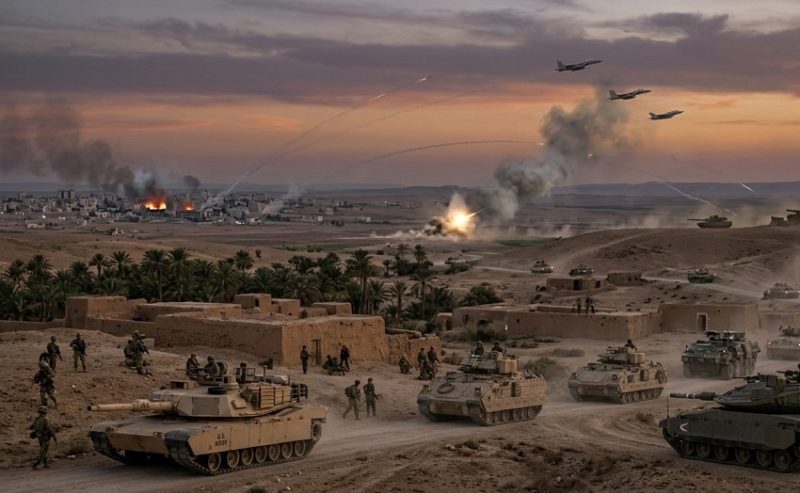
The specter of full scale war in the Middle East, particularly involving the United States, Israel, and Iran, is a terrifying reality that looms constantly on the global horizon. While discussions around such a conflict predictably focus on human casualties, geopolitical shifts, and economic devastation, another, less-examined victim awaits in the shadows: the environment.
A full-scale conflict in this volatile region, given the specific geographies and technological capabilities of the potential belligerents, would not just be a human tragedy but an environmental apocalypse with global ramifications. The immediate and long-term impacts on the air we breathe, the water we drink, and the ecosystems that sustain life would be catastrophic and, in many ways, irreversible.
This article explores the multi-faceted environmental footprint of a US-Israel-Iran war, detailing how military operations could poison the planet for generations.
The Immediate Fallout: Fire, Dust, and Atmospheric Poison
The opening moves of any modern conflict in this scenario would inevitably involve massive aerial bombardments and missile strikes. The targets would be strategic: nuclear facilities, energy infrastructure, missile silos, and command centers. The environmental impact would be immediate and severe.
1. Targeting Oil and Energy Infrastructure: The Fires of Black Rain
Iran is a global hub of the fossil fuel industry. Israel, too, has critical oil and gas terminals. Attacks on refineries, pipelines, and storage facilities are a primary military tactic to cripple an adversary’s war machine. However, the environmental consequence is a phenomenon known as “black rain.”
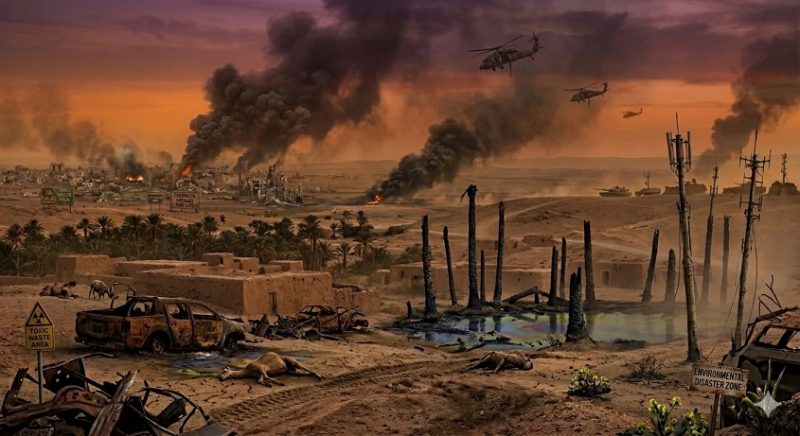
The burning of millions of barrels of crude oil would release unprecedented volumes of toxic smoke, soot, and greenhouse gases into the atmosphere. The massive oil fires in Kuwait during the 1991 Gulf War provide a chilling blueprint. The resulting smoke plumed for months, blackening the skies, creating respiratory crises across the region, and leading to oily, toxic rain (black rain) falling as far away as the Indian subcontinent.
A similar, perhaps even larger, conflagration in Iran, particularly in the oil-rich Khuzestan province, would not just release catastrophic amounts of CO2, accelerating global warming. It would also shower toxic particles—heavy metals, carcinogenic hydrocarbons, and particulate matter (PM2.5)—over thousands of square miles. This pollution would poison agricultural land, contaminate water bodies, and create a multi-year public health crisis in neighboring countries like Iraq, Turkey, and the Gulf states.
2. The Nuclear Red Line: Contamination or Meltdown
The most horrifying scenario involves strikes on nuclear facilities, particularly Iran’s Natanz or Fordow enrichment plants, or the Bushehr nuclear power reactor. While the US and Israel might attempt precision strikes to disable centrifuges without causing a meltdown, the margin for error is razor-thin, and the consequences of failure are absolute.
An attack that leads to a reactor meltdown (like Chernobyl or Fukushima, but caused by bombs) or the dispersal of enriched uranium would release massive amounts of radioactive material into the atmosphere.
The radioactive plume would not respect national borders. Depending on wind patterns, radioactive fallout could contaminate large swathes of the Middle East, Central Asia, and even parts of Europe and the Caucasus. This would lead to long-term contamination of soil and groundwater, spike cancer rates, and make large territories uninhabitable for decades. The cleanup would be practically impossible.
3. Particulate Matter and the Destruction of Topsoil
Even conventional warfare unleashes environmental chaos. Massive explosions, artillery barrages, and the movement of heavy military vehicles destroy fragile topsoil and release tons of dust and particulate matter into the air.
In the arid and semi-arid landscapes of the Middle East, where dust storms are already a significant problem (the “dust bowl” effect), the disruption of the soil crust would lead to a dramatic increase in the intensity and frequency of severe dust storms. These storms transport pathogens, pollutants, and fertilizers over vast distances, suffocating agriculture and ecosystems, while posing severe respiratory risks to populations across the hemisphere.
The Hydro-Ecology Nightmare: Water Scarcity and Marine Disaster
The Middle East is already one of the most water-stressed regions on Earth. War would exacerbate this vulnerability to a catastrophic degree.
1. Targeting Water Infrastructure as a Weapon of War
Water treatment plants, desalination facilities (crucial this region), dams, and irrigation systems are vulnerable infrastructure. Destroying them not only causes immediate human suffering but also leads to environmental devastation.
Untreated sewage and chemical runoff from bombed factories would flow directly into rivers like the Tigris and Euphrates or the Shatt al-Arab. These vital waterways would become poisonous canals, killing fish, destroying riparian ecosystems, and making the water unusable for agriculture. This contamination would seep into groundwater, which supplies millions of people.
Furthermore, a Scorched Earth policy, the deliberate destruction of dams to flood territories and impede enemy movement—would lead to massive ecosystem loss and displacement, poisoning farmland with saline or toxic sediment.
2. Marine Destruction in the Persian Gulf
The Persian Gulf is one of the most important marine ecosystems on the planet, but it is also one of the most vulnerable. It is a shallow, narrow waterway already heavily impacted by oil industry activities.
A war, particularly one targeting shipping and offshore oil platforms, would lead to massive, uncontrollable oil spills. Unlike in deep, open oceans, oil in the enclosed Gulf cannot easily disperse. It would coat the unique mangrove forests of Iran (vital fish nurseries), destroy coral reefs (crucial hotspots of biodiversity), and devastate the dugong and sea turtle populations. The destruction of this ecosystem would ripple out, crippling regional fishing industries and leading to species collapse.
The Long-Term Scars: Soil Degradation and Biodiversity Loss
1. Unexploded Ordnance and Chemical Contamination
Wars do not end when the fighting stops. The environment inherits a toxic legacy. Millions of landmines, cluster submunitions, and unexploded bombs would litter the landscape.
Over time, these materials degrade, leaching toxic heavy metals (like lead, mercury, and tungsten) and persistent organic pollutants (like RDX) into the soil and groundwater. These chemicals are non-biodegradable and enter the food chain, leading to long-term health crises for humans and wildlife. Decades after the Vietnam War and the Gulf Wars, communities still suffer from the toxic legacy of unexploded ordnance (UXO) and chemical agents (like Agent Orange or depleted uranium).
2. The Irreversible Loss of Wildlife and Habtitats
War creates refuges for no one. Habitats are destroyed by bombing, military movement, and pollution. Animals are caught in the crossfire, or their migration routes are disrupted.
In Iran, unique and endangered species like the Asiatic Cheetah, the Persian Leopard, and various gazelle species, already fighting for survival, would likely face extinction. The destruction of key ecosystems—whether the Zagros Mountains, the Iranian plateau, or the Mesopotamian marshes—means the loss of biodiversity that can never be recovered. When habitats are destroyed by chemical contamination or radioactivity, the possibility of reintroduction is lost for centuries.
A Threat to Global Environmental Cooperation
The environmental impact extends beyond direct ecological damage. A war of this magnitude would shatter the international framework for environmental cooperation.
Climate change, water sharing, and pollution control in the Middle East require regional diplomacy and joint monitoring. War makes this impossible. Trust evaporates, institutions are destroyed, and resources are diverted away from environmental protection toward military survival. The global fight against climate change, already faltering, would be set back decades as nations prioritize rearmament and resource acquisition in a fractured world order.
Conclusion
A war between the US, Israel, and Iran is not just a geopolitical or humanitarian nightmare; it is an ecological apocalypse. The targeting of energy and nuclear infrastructure, the inevitable widespread pollution, the destruction of vital water resources, and the irreversible loss of biodiversity would create a environmental catastrophe that transcends generations and borders.
The environment is the silent casualty of all conflicts, but in this specific scenario, given the geography and technology involved, the environmental destruction would be so profound it could redefine the habitable landscape of the Middle East and cast a toxic cloud over the entire globe. In the calculus of war, the environmental cost must be reckoned not as collateral damage, but as a central, devastating outcome of the conflict itself.
Check Out: Environmental Impact of the Russia-Ukraine War
We hope you all liked this post! Please, comment below if you have any suggestions, comments, or feedback! We #envpk love hearing from our readers! Thanks!